
Launa for WooCommerce is the agentic commerce extension for WooCommerce. It is not only a payment method.
Buying agents can discover and search your catalog, create a cart, check out, and pay — using Universal Commerce Protocol (UCP) and x402. Human shoppers get the same x402 wallet payment on the store pay page. You keep WooCommerce for products, customers, and orders.
The x402 hop on the UCP surface follows AxLabs/ucp-x402-binding.
This plugin was previously Ax402 for WooCommerce. Ax402 was rebranded to Launa, so the plugin is now Launa for WooCommerce. The WordPress.org slug stays ax402-for-woocommerce. The source repository is now AxLabs/launa-woocommerce-extension.
Your wallets. No take rate on sales.
You set the payout wallets (one EVM address for all EVM networks, plus a Hedera account if you enable Hedera tokens). Settlements go to those wallets. There is no payment intermediary that holds the funds.
Launa facilitates settlement: payment endpoints, the token list, and confirmation. Launa does not take a percentage of products sold.
Catalog prices stay in USD. Shoppers and agents pay in the settlement tokens you enable from your Launa platform config (for example USDC). Launa covers network fees for those payments.
Works with classic checkout, Cart / Checkout Blocks, and HPOS.
You need a Launa merchant account and API key.
For merchants
- WooCommerce payment method
launawith a readiness checklist - Settlement tokens synced from Launa (stablecoins 1:1 with the USD total; other tokens use Launa FX)
- Human pay page: wallet connect, network switch, balance checks
- Orders stay in WooCommerce Orders
- Optional “Powered by Launa” on the pay page (off by default)
For buying agents
- UCP discovery at
/.well-known/ucpand shopping at/wp-json/ucp/v1(catalog, cart, checkout, order, MCP) - x402 payment required at checkout complete — agents pay
resource.url, then complete again - Legacy agent REST at
/wp-json/launa/v1(products, create order, status)
UCP is on by default. Turn it off in Launa settings if you do not want agent discovery. That does not change the human pay page.
External services
This plugin does not include analytics, advertising pixels, or other tracking. It contacts the services below only to run Launa / x402 payments (and Hedera wallet connect when you enable it). Saving a Launa API key in WooCommerce settings is consent to use Launa. WalletConnect, Hedera Mirror Node, and public RPC calls run in the shopper’s browser when they choose to pay.
Launa
Launa (operated by AxLabs) creates payment endpoints, syncs settlement tokens, confirms settlements, and serves the gateway the shopper or agent pays. The browser and WordPress may call your assigned gateway host (*.launa.io) under the same operator.
- When: configuring the gateway, placing a Launa order, loading the pay page, refreshing tokens, verifying payment, and (server-side) proxying or reconciling a payment when needed
- Data sent: API key, pay-to wallet, order totals / amounts, order keys, selected settlement token, store origin for CORS, settlement references. No card data or wallet private keys
- Service · Terms · Privacy · Disclaimer
Chain metadata (GitHub / ethereum-lists)
When a settlement token does not already include a chain name, public RPC, or explorer URL, the plugin may fetch one public Ethereum chain JSON file from the GitHub Contents API (eip155-{id}.json), cached 24 hours per chain. Dataset: ethereum-lists/chains (MIT).
- When: resolving a display name, public RPC, or explorer for an EVM network that lacks those fields on the Launa token
- Data sent: HTTP GET with Accept and GitHub API version headers. The path includes the numeric chain id. No personal data, API keys, or order data
- Service · Terms · Privacy
WalletConnect / Reown
On the pay page, when a shopper selects Hedera settlement and you have set a WalletConnect project ID, the browser uses WalletConnect / Reown to connect a Hedera wallet (for example HashPack), including relay traffic such as https://rpc.walletconnect.com/.
- When: only after the shopper starts Hedera wallet connect on the pay page
- Data sent: project ID, dapp metadata (store name and URL), session data, and the wallet account id used for signing. Private keys stay in the wallet
- Reown terms · WalletConnect terms
- Reown privacy · WalletConnect privacy
- Docs
Hedera Mirror Node
The shopper’s browser may query public Hedera Mirror Node REST (mainnet-public.mirrornode.hedera.com / testnet.mirrornode.hedera.com) for token balances and network readiness.
- When: when a shopper pays with a Hedera settlement token
- Data sent: Hedera account id and token id in public REST paths. No private keys
- Terms · Privacy
Public EVM RPC endpoints
The shopper’s browser may call public EVM JSON-RPC URLs from token metadata or ethereum-lists chain files (via the GitHub Contents API) for balance checks, chain switching, and payment signing. Exact RPC URLs vary by chain. Wallet extensions (for example MetaMask) run locally; private keys never leave the wallet.
UCP discovery JSON may include protocol spec URLs (ucp.dev, x402 UCP payment handler schema, ucp-x402-binding). Those are documentation identifiers, not APIs this plugin calls.
Development
Active development, pull requests, and issue tracking are on GitHub, not WordPress.org SVN:
https://github.com/AxLabs/launa-woocommerce-extension
Related AxLabs repositories:
- AxLabs/launa-woocommerce-extension — this plugin
- AxLabs/ucp-x402-binding — UCP × x402 payment binding
- GitHub Releases — full changelog per version
WordPress.org SVN is a publish snapshot of tagged releases for the Plugin Directory.
Minified frontend assets live in build/. Readable source, build tooling, and third-party license notes are in the GitHub repo. See also assets/THIRD_PARTY_LICENSES.md in the plugin package.
npm --prefix plugin ci
npm --prefix plugin run build
# Optional lean EVM-only bundle (stubs Hedera): LAUNA_EVM_ONLY=1 npm --prefix plugin run build
The default build includes Hedera WalletConnect support (~2MB pay-page bundle).
Screenshots
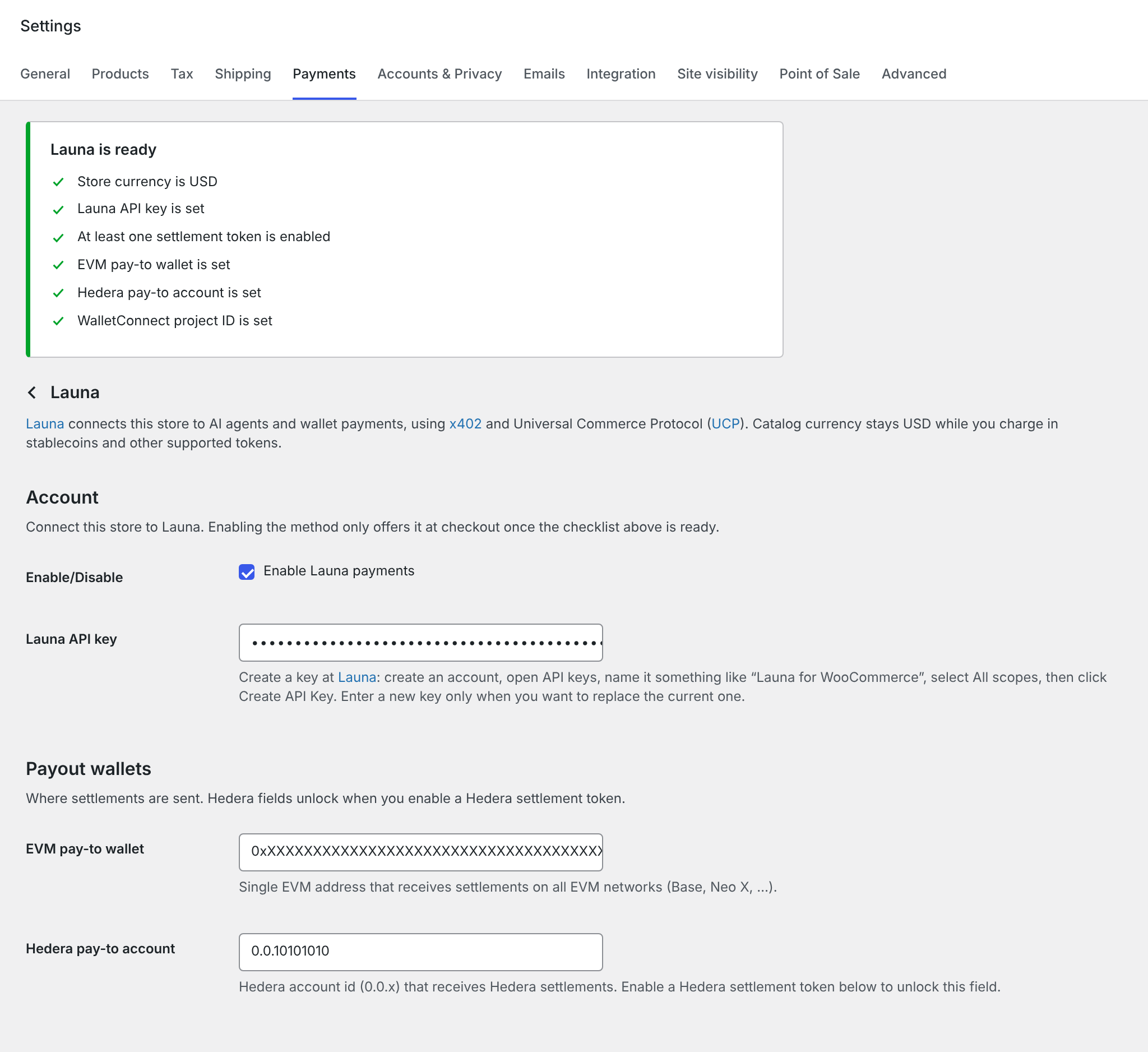
Gateway settings: readiness checklist, API key, and payout wallets you control.
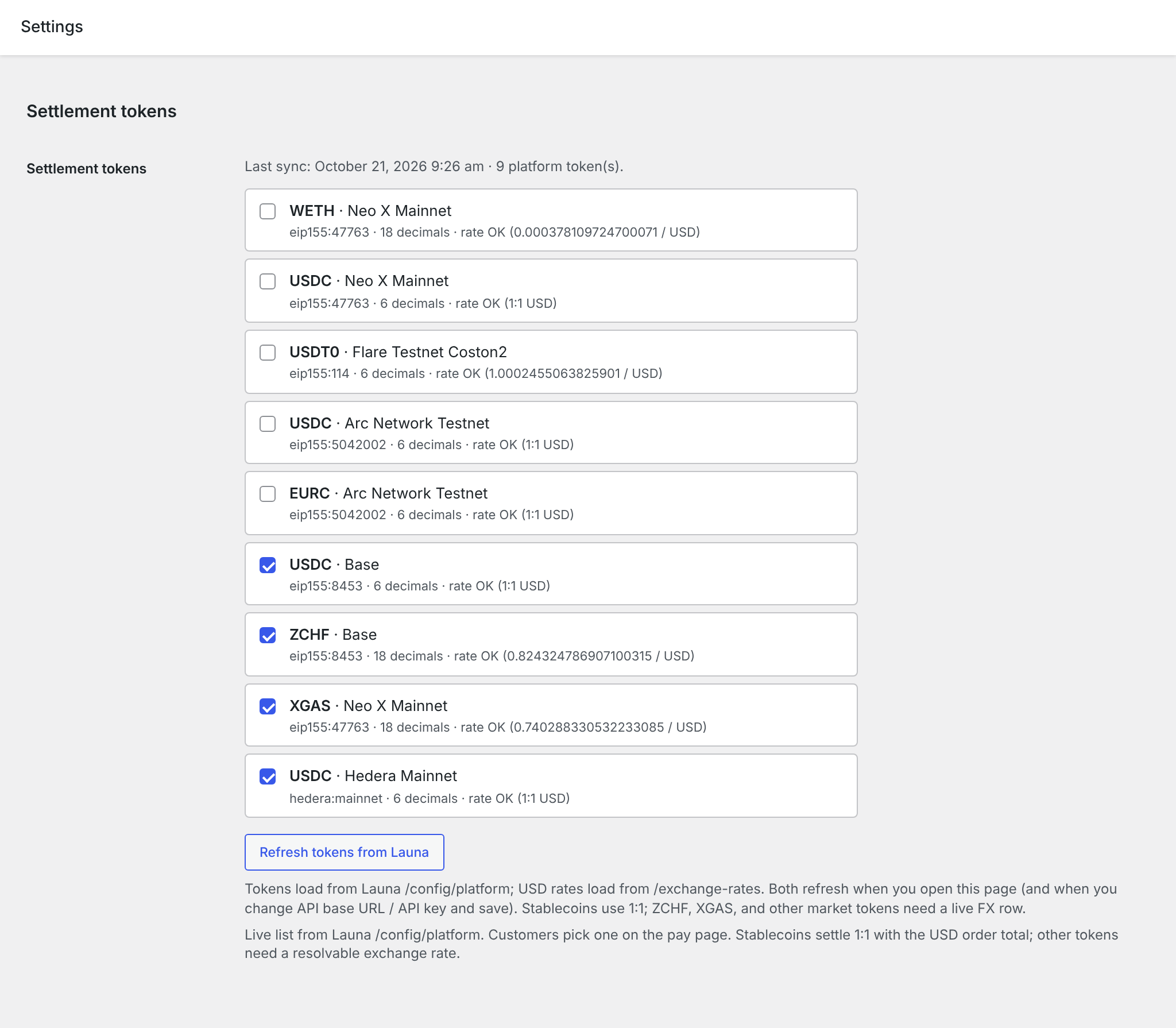
Settlement tokens synced from Launa. Enable the assets you want; customers pick one at pay time.
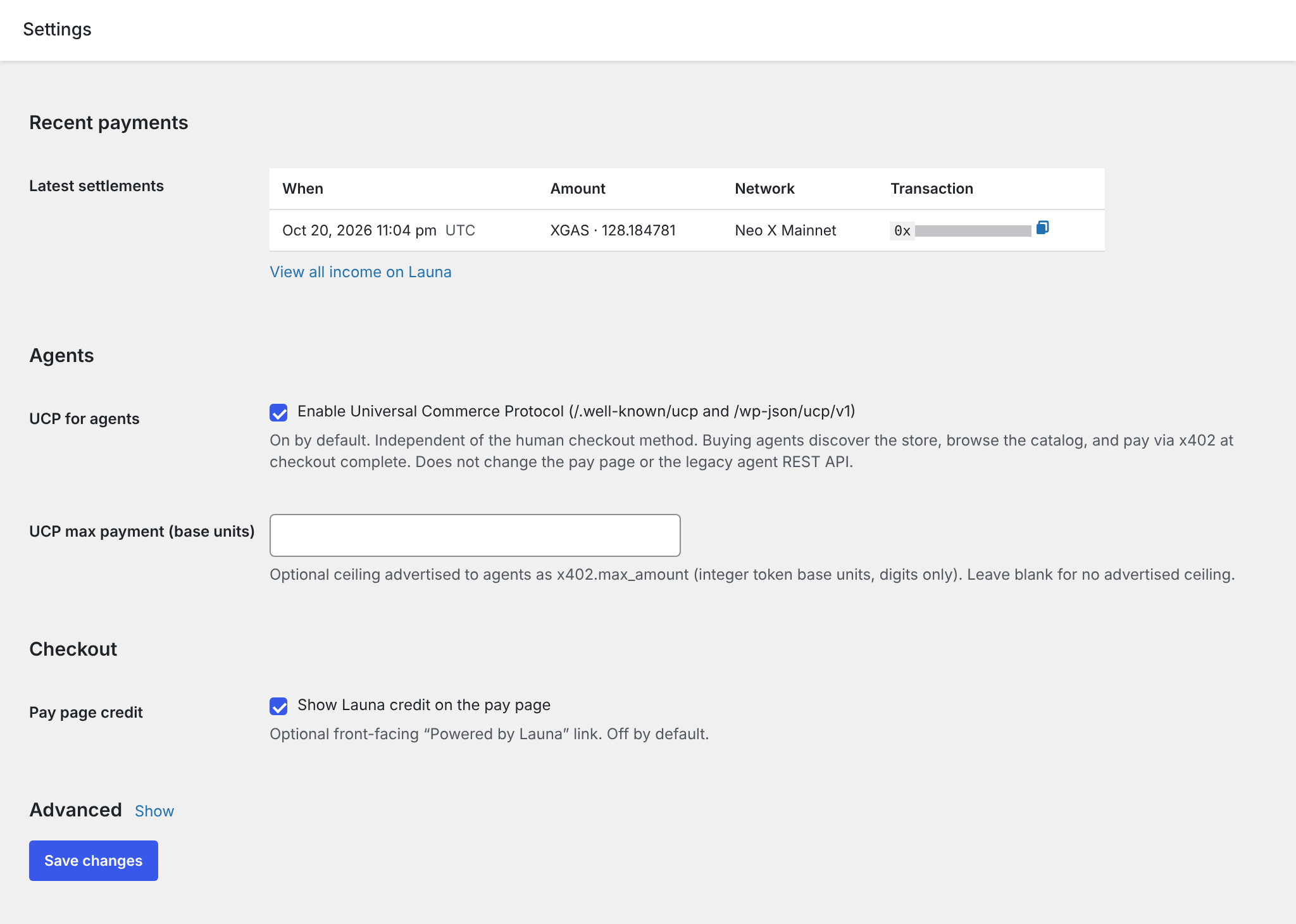
Recent settlements, UCP for buying agents, and optional pay-page credit.
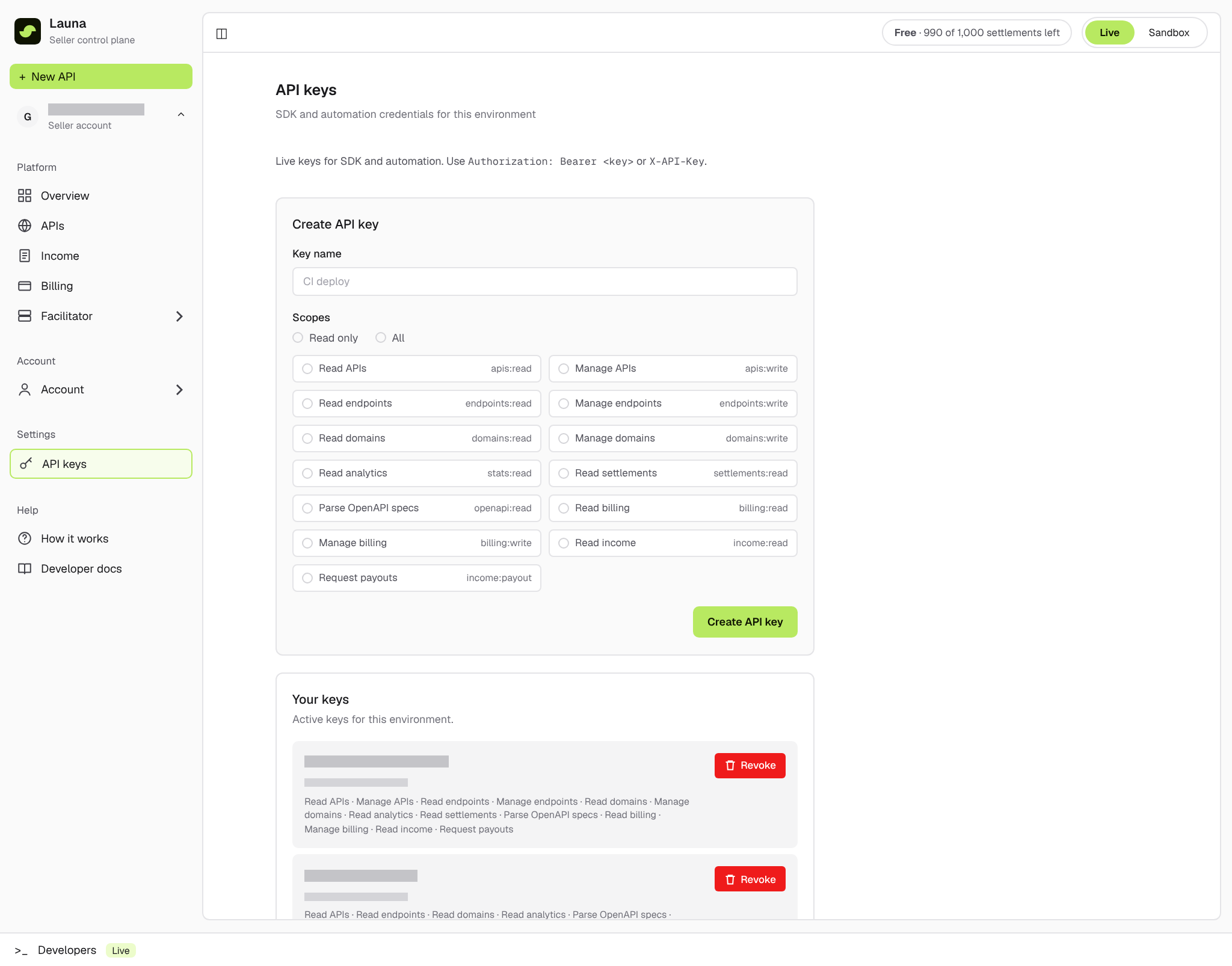
Create a Launa API key in the merchant dashboard.