
Writing the post is the work. Remembering to pin it, three days later, is the part that quietly stops happening.
This plugin is Pinterest automation for WordPress: it schedules Pinterest Pins for you, automatically, from the content you already publish. Burnpedia Pin Scheduler connects your WordPress site to your Burnpedia account; when a post goes live, it builds a Pin from that post’s image, title and link and hands it to Burnpedia to publish on a schedule — to the board you picked, at a sensible time, without you opening Pinterest.
It works the same way for a blog post, a page, a WooCommerce product or any other public post type, and it can pin the archive you published before you installed it as well as everything you publish from now on.
What it does
- Creates a Pin automatically when a post is published — or only for the posts you tick.
- Pins posts, pages, WooCommerce products and any other public post type you switch on.
- Uses the featured image, or the first image in the post if there is no featured image.
- Makes up to six Pins from one post, each using a different photograph, a day apart.
- Designs a cover from the post’s title when the post has no image at all — free, and at the size Pinterest likes.
- Sends the Pin to one fixed board, a board per category, or a board named after your site. A board that does not exist yet is created for you.
- Writes the Pin title and description from templates with
{title},{excerpt},{site}and{categories}tags — editable per post. - Adds UTM campaign tags to the link (
utm_source=pinterest…) so Pinterest traffic shows up in Google Analytics or whatever you use. Links that are already tagged are left alone. - Schedules with a delay, so your caches and CDN are warm before Pinterest fetches the image.
- Retries by itself when something goes wrong, and waits for the reset when you have used up the day’s allowance.
- Bulk-pins the posts you published before installing, spread over safe best-time slots rather than sent in one burst.
- Reports impressions, saves and link clicks for the Pins from this site. The site total is on every plan, free included; the per-post breakdown, next to each post in the posts list, is on the paid plans.
- Shows what happened, per post, in an Activity log — including the posts it skipped and why.
- Works in the block editor and the classic editor; the per-post Pinterest panel appears in both.
Works on the free plan
Nothing here is locked by the plugin: no trial, no time limit, no feature switched off until you pay us for the plugin. A free Burnpedia account publishes up to 3 Pins a day, and every part of the publishing side — automatic pinning, boards, templates, UTM tags, scheduling, retries, bulk-pinning the backlog, the Activity log — works on it.
One reporting feature is paid: the per-post breakdown of how each post’s Pins are doing. The site-wide total is on every plan, free included. Paid plans also raise the daily allowance and add AI-written Pin copy and AI images. See burnpedia.app/pricing.
You keep your Pinterest password
The plugin never sees your Pinterest credentials. You connect Pinterest once inside Burnpedia, on Pinterest’s own login screen, over the official Pinterest API.
Open source
The plugin is GPL. Its source, and the API it talks to, are documented at burnpedia.app/developers.
External services
This plugin is a client for Burnpedia, a Pinterest scheduling service run by Burnpedia at https://burnpedia.app. The plugin cannot work without it: WordPress has no way to publish to Pinterest on its own, and Burnpedia is what holds the Pinterest connection.
Nothing is sent anywhere until you ask for it. With no key saved, the plugin makes exactly one kind of outbound request, and only after you press a button for it — the one-press connection described immediately below. Nothing happens on activation, and nothing happens on its own.
Connecting this site in one press (optional). On the Connection screen you can press Connect this site to Burnpedia instead of copying an API key by hand. When you press it:
- Your browser opens
https://burnpedia.app/connect/wordpress, carrying the address of this site and its title, so that the approval screen can name the site you are about to connect. It also carries a random one-time request ID and a fingerprint of a secret that never leaves your server. - After you approve it there, this site makes one
POST https://burnpedia.app/api/site-connect/claimrequest, sending that request ID and the secret, and receives an API key which is saved for you. The key is never shown in your browser. - The request expires after fifteen minutes and can be collected only once. If you press Cancel, or never approve it, nothing is sent and nothing is created.
- You never have to use it: pasting a key by hand still works exactly as before, and is the way to connect a site that cannot reach the internet.
Once a key is saved, the plugin contacts https://burnpedia.app/api/v1 in these situations:
- When you open the plugin’s settings screen or press “Check connection” — a
GET /api/v1/merequest that returns your Burnpedia plan, the Pinterest accounts connected to it, how much of today’s Pin allowance you have used and when it resets, and — only while a Pro trial is running — how many days of it are left together with a short-lived link that opens checkout with the plan already chosen. Sent: your API key. Nothing new is sent for any of that; it is the same request, answered with more. The post editor reads the same answer (from a five-minute copy, so opening posts does not repeat the request) to decide whether to offer an AI cover and to show its price and your AI points balance. - When you press “Load my boards” — a
GET /api/v1/boardsrequest. Sent: your API key. - When a post is published (with automatic pinning on), or you press “Pin this post now” — a
POST /api/v1/pinsrequest. Sent: your API key, the Pin title, the Pin description, the post’s public permalink, the URL of the post’s image, the board name or id, and the time the Pin should be published. If the post has no image and you have left “design a cover from its title” switched on, no image URL is sent and a flag is sent instead, asking Burnpedia to design the cover from the title above. If you also switched on “let Burnpedia generate one with AI”, that same flag asks for the cover to be drawn over a generated photograph, which spends AI points on your Burnpedia account; if it cannot be generated you get the free designed cover instead and are not charged. Nothing extra about your site is transmitted for either. - When you open the “Pins from this site” tab — a
GET /api/v1/pinsrequest. Sent: your API key and this site’s address, so that Burnpedia returns only the Pins that link to this website rather than every Pin on your account. - When you open the “Pins from this site” tab, or the posts list in WordPress — a
GET /api/v1/analytics/siterequest. Sent: your API key and this site’s address. It returns the impressions, saves and clicks Burnpedia has already recorded for your Pins; it does not ask Pinterest anything, so it cannot use up your Pinterest rate limit. - When you press “Make a preview” under “Try an AI cover” in the post editor — a
POST /api/v1/coversrequest. Sent: your API key, the Pin title, the post’s public permalink, and a flag asking for an AI photograph. It uses AI points on your Burnpedia account (the panel shows the cost and your balance before you press it) and creates no Pin: the picture is shown to you, and it is pinned only if you then press “Pin with this cover”, which sends the Pin request described above with that picture’s URL. If the picture cannot be made you are not charged.
Every request also carries a header naming the plugin and its version (for example wordpress/1.0.0), the same way a browser identifies itself, so that support and compatibility questions can be answered.
No visitor data, no analytics, no usage statistics and no content beyond the fields listed above are transmitted. The plugin has no telemetry of its own: it never reports your traffic, your other plugins, or anything about your visitors. Your site’s address is sent as part of a Pin’s own link, when looking up this site’s Pins as described above, and — if you use it — on the one-press connection screen so that it can name the site you are approving.
Your use of the service is covered by Burnpedia’s terms and privacy policy:
- Terms of service: https://burnpedia.app/terms
- Privacy policy: https://burnpedia.app/privacy
Pinterest itself is contacted by Burnpedia’s servers, not by your site. Note that Pinterest downloads your image from your own site, so the image URL has to be publicly reachable — the settings screen warns you when it looks like it is not.
The install count (optional, off by default). WordPress.org does not tell
plugin authors how many sites are running their plugin — for this plugin it
publishes no figure at all. If you switch this on under Burnpedia Pins Connection, this site
sends a short report:
POST https://burnpedia.app/api/plugin-insights— once when you switch it on,
then at most once a week while an administrator is using wp-admin, once if you
deactivate the plugin, and once if you delete it. Sends exactly nine things: a
random ID generated on this site, which plugin and which version, which of
those four events it is, your WordPress version, your PHP version, your site
language, whether this is a multisite network, and whether an API key is saved
(true or false — never the key). Receives: nothing your site uses.
Your website address is not in that report and is never sent, so we cannot
tell which website you are. The random ID is made up on your server and means
nothing outside it. Switch the setting off and the ID is deleted, so counting
stops and a later change of mind cannot be joined to it. It is off until you
choose it, no feature depends on it, and nothing about any reader or any
logged-in user is in it.
Screenshots
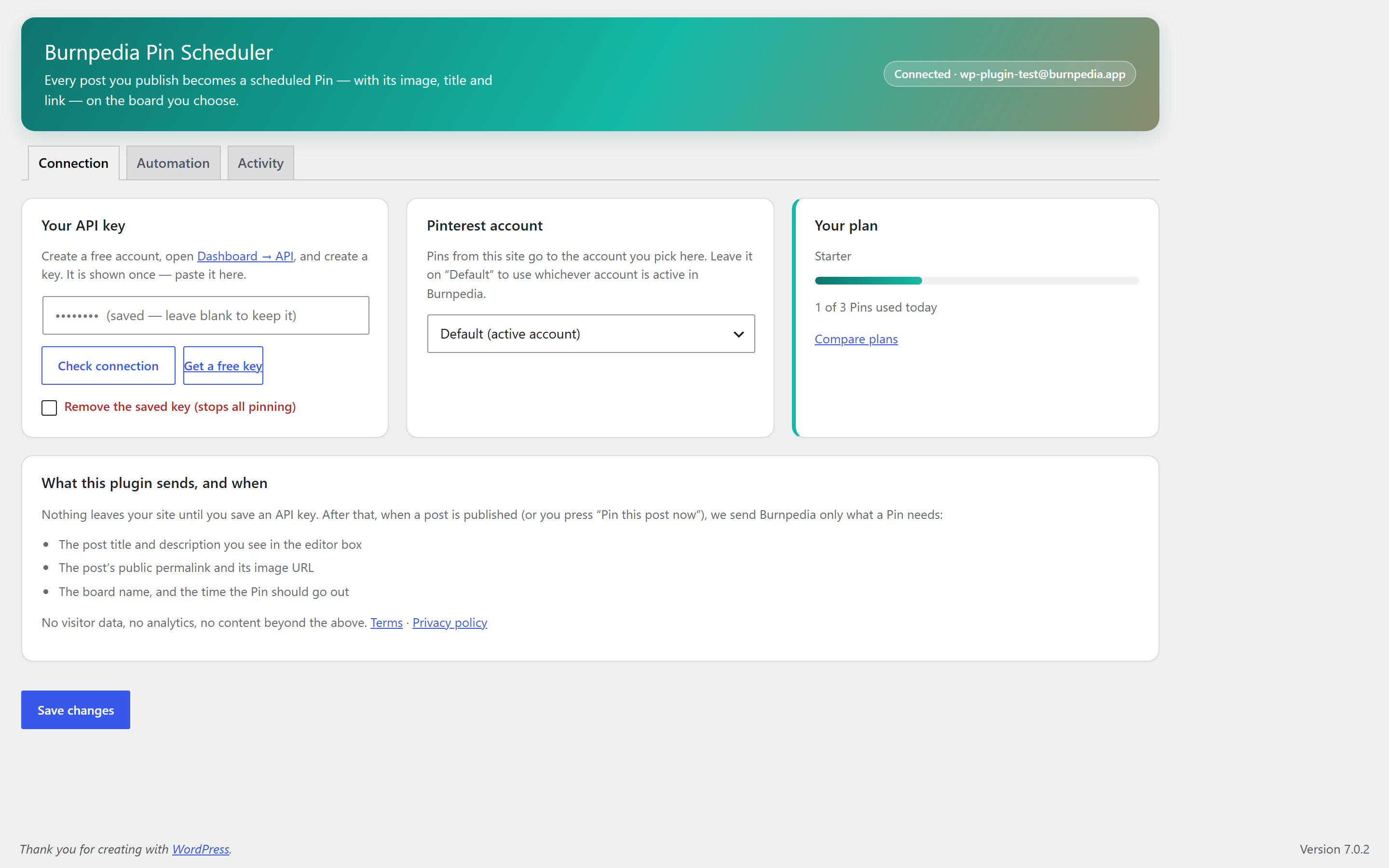
The settings screen: connection status, plan, and today's Pin allowance.
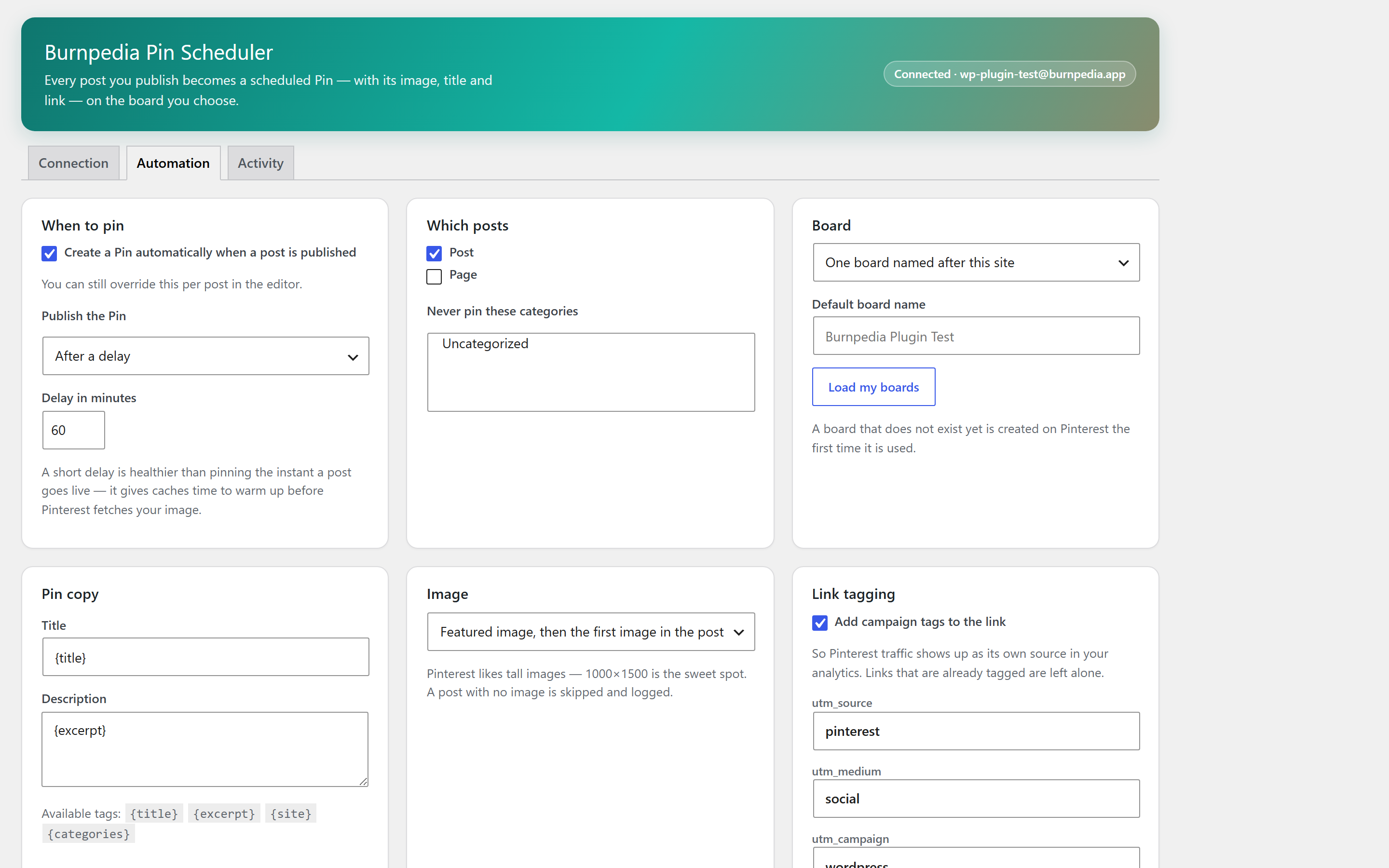
Automation settings — when to pin, which posts, which board.
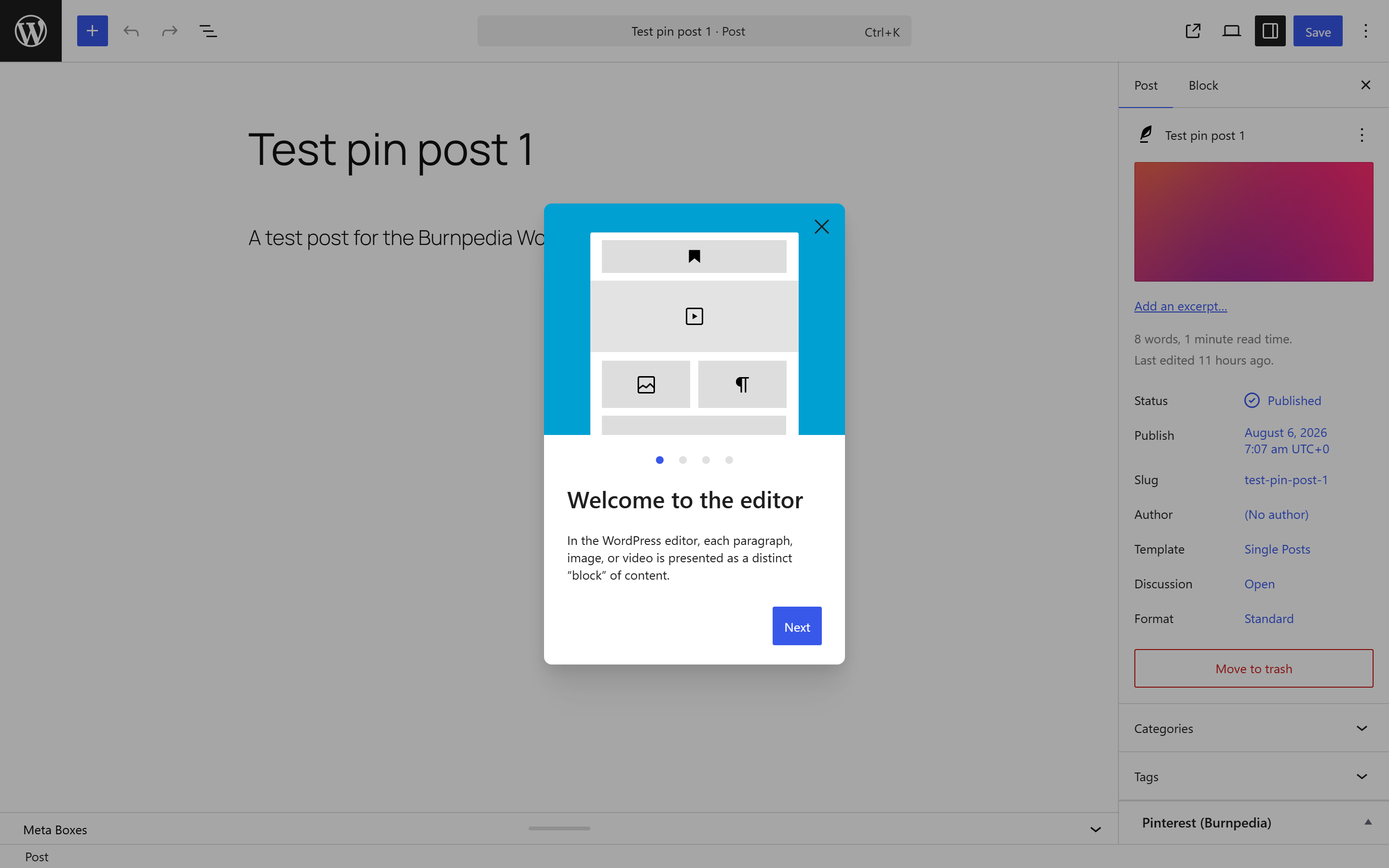
The Pinterest box in the post editor, with per-post title, description and board.
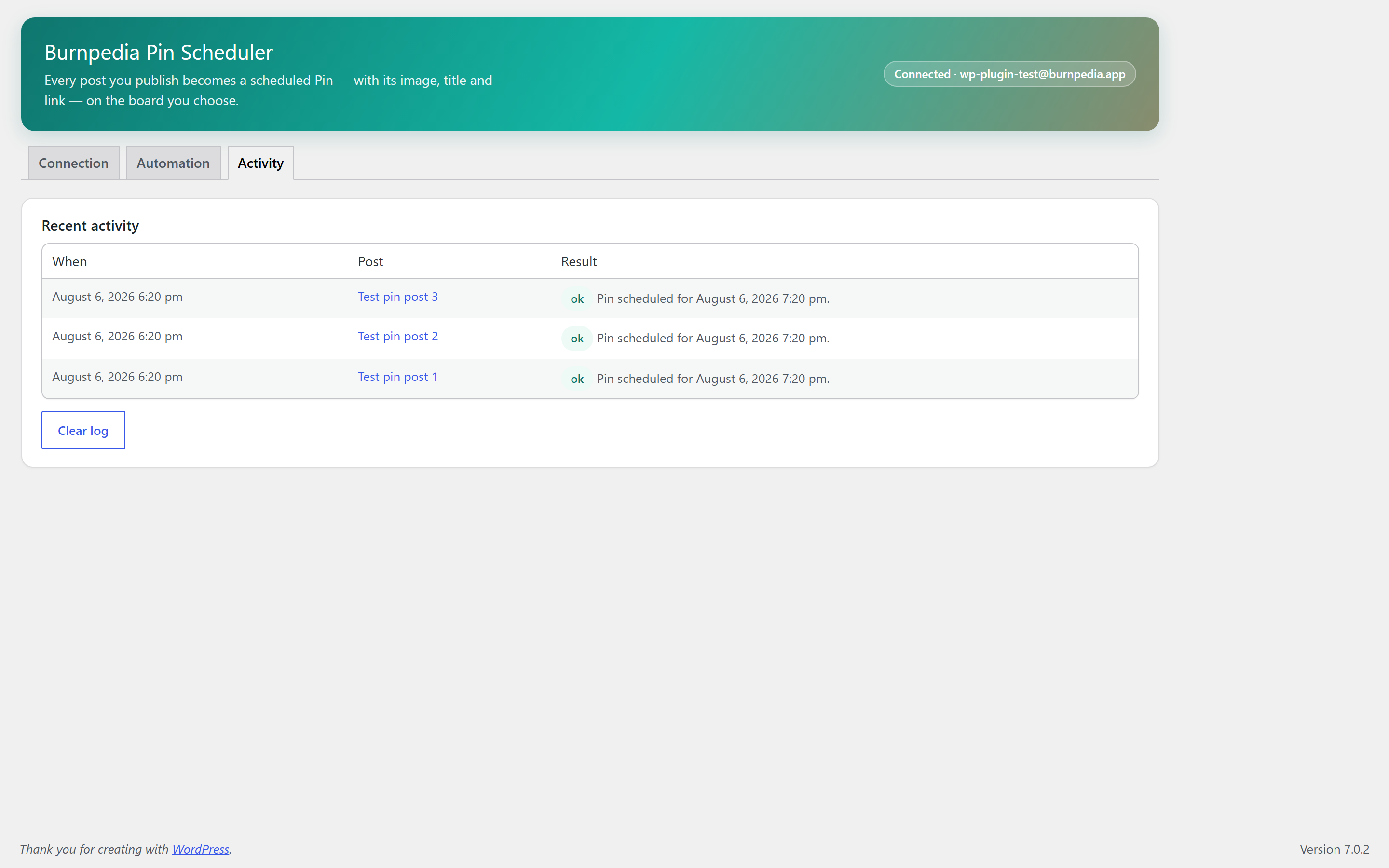
The Activity log: what was pinned, what was skipped, and why.