Dynamic Functionalities replaces the stack of single-purpose plugins most WordPress sites depend on. Instead of installing separate plugins for performance cleanup, redirect management, login security, schema markup, external link control, and code snippets, you get 16 purpose-built modules in one package that loads less code than most individual plugins.
Every module is independent. Enable what you need, disable what you don’t. Disabled modules load zero code — no hooks, no files, no queries.
Full documentation lives at functionalities.dev, including a module reference, a getting started guide, and a complete hook reference.
New in 1.6.0
A security and correctness release, tested on WordPress 7.1.
- Abilities API permissions tightened. Each WordPress 7 ability now carries its own permission callback and rejects undeclared input. Previously a shared callback widened to
edit_postwhenever a request carried apost_id, so anyone who could edit a single post could reach administrator-only operations. - Data files moved somewhere private. Redirects, the 404 log, and task notes now live in a folder with a random name and are no longer readable at a guessable URL. Existing files migrate automatically.
- Snippets reach visitors intact. Header and footer code is filtered once at save time against the author’s capability instead of being re-filtered against each visitor’s, which used to mangle
&&and comparison operators for logged-out readers. - Content filters use the WordPress HTML API. Link Management, Block Cleanup, and Schema edit attributes in place instead of reserializing through DOMDocument. Pages built with Vue, Alpine, or mustache templates are processed correctly rather than skipped.
Existing settings, hooks, admin URLs, and data files carry over untouched. The full list is in the changelog below.
Why Not Just Use Separate Plugins?
A typical WordPress site runs 5-10 utility plugins that each load their own CSS, JS, options, and database queries on every page load. Dynamic Functionalities consolidates these into a single plugin with shared infrastructure:
- One autoloader instead of 16 separate plugin bootstraps
- Shared options caching across all modules (static properties, not repeated DB calls)
- Zero frontend assets unless a module explicitly requires them
- Single admin menu instead of scattered settings pages
What It Replaces
Here’s what you can deactivate after installing Dynamic Functionalities:
- Redirection / Safe Redirect Manager / 301 Redirects — The Redirect Manager module handles 301, 302, 307, and 308 redirects with file-based storage (no database bloat)
- Limit Login Attempts Reloaded / WP Limit Login / Login LockDown — Login Security module covers login attempt limiting, lockout durations, XML-RPC blocking, and login error hiding
- External Links / WP External Links — Link Management module automates nofollow, new tab behavior, and exception lists with JSON preset support
- Schema Pro / Schema & Structured Data — Schema Settings module adds microdata with itemscope/itemtype support and BreadcrumbList JSON-LD
- Insert Headers and Footers / WPCode — Header & Footer Snippets module handles GA4 integration and custom code injection
- Asset CleanUp / Perfmatters — Performance & Cleanup module disables emojis, embeds, REST API links, XML-RPC, feeds, Gravatars, heartbeat, and more
- SVG Support / Safe SVG — SVG Icons module lets you upload and insert SVG icons inline in the block editor
- Use Any Font / Custom Fonts — Fonts module registers custom font families with @font-face, WOFF2/WOFF, variable font support, and Bricks Builder integration
- PWA for WP / Super Progressive Web Apps — Progressive Web App module makes your site installable with service worker support
Modules That Don’t Have Alternatives
Some modules solve problems no other free plugin addresses:
- Content Integrity — Monitors posts for structural regressions on update: dropped internal links, word count drops, heading structure changes. Catches accidental content loss before it goes live.
- Assumption Detection — Watches for technical assumptions that silently break: schema collisions from conflicting plugins, duplicate analytics tags, redundant font loading, missing expected elements.
- Components — Define reusable CSS components as selector + rules pairs. Auto-enqueued site-wide without a page builder or theme dependency.
- Task Manager — File-based project management inside WordPress admin. No external service, no database tables, no SaaS subscription.
- Block Cleanup — Strips wp-block classes from frontend HTML for sites that don’t need them. Cleaner markup, smaller DOM.
- Editor Link Suggestions — Limits the block editor link autocomplete to specific post types. Stops irrelevant suggestions from cluttering the link picker.
Performance First
- Modular & lazy loaded — Only active modules run code. A front-end request with every module disabled loads zero feature files.
- Static property caching — Options are read once per request, not on every hook
- Fast-exit content filters — strpos() checks run before any parsing happens
- WordPress HTML API — Content filters edit attributes in place instead of reserializing the document, so markup comes out the way you wrote it
- Transient caching — Heavy operations (JSON parsing, file I/O) are cached
- No frontend bloat — No CSS or JS loaded unless a module explicitly needs it
Developer Friendly
- Clean namespaced codebase:
Functionalities\Features\*,Functionalities\Admin\* - All hooks prefixed with
functionalities_for safe filtering — see the hook reference - Every module exposes filters for customization, documented in the API reference
- WordPress 7 Abilities API operations, each behind its own capability check
- PSR-4-like autoloader with zero dependencies
- GPL-2.0-or-later — fork it, extend it, contribute back
Documentation & Support
- functionalities.dev — Documentation home
- Getting started — Install, enable your first module, and verify it
- Module reference — What each of the 16 modules does
- Dashboard guide — Working with the module dashboard
- Hooks and API reference — For developers extending the plugin
- FAQ — Common questions answered in more depth than this page
- Downloads — Current and previous releases
- Training — Step-by-step module walkthroughs
- GitHub Issues — Bug reports and feature requests
- WordPress.org Support — Community support forum
Screenshots
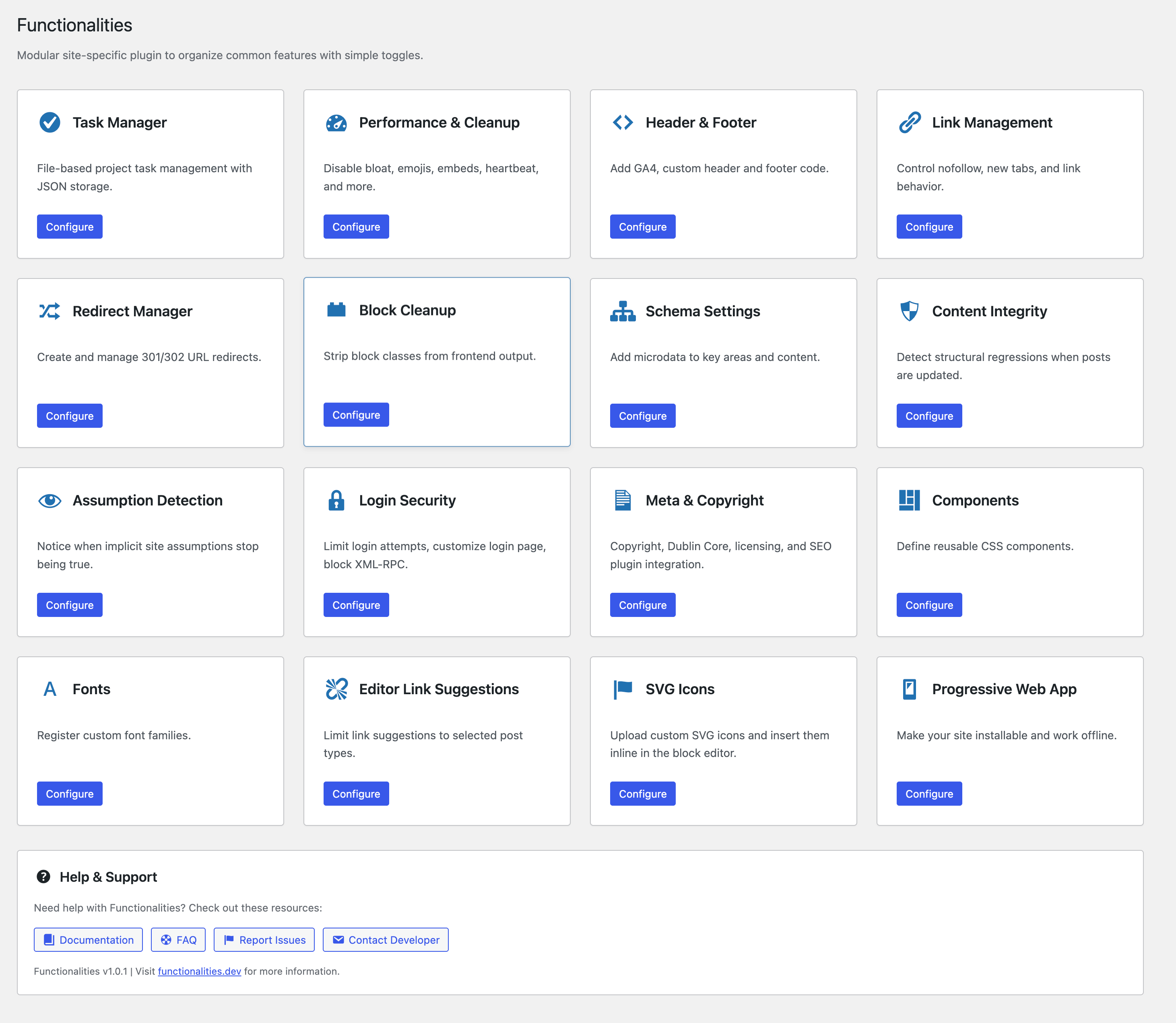
Dashboard overview with module cards
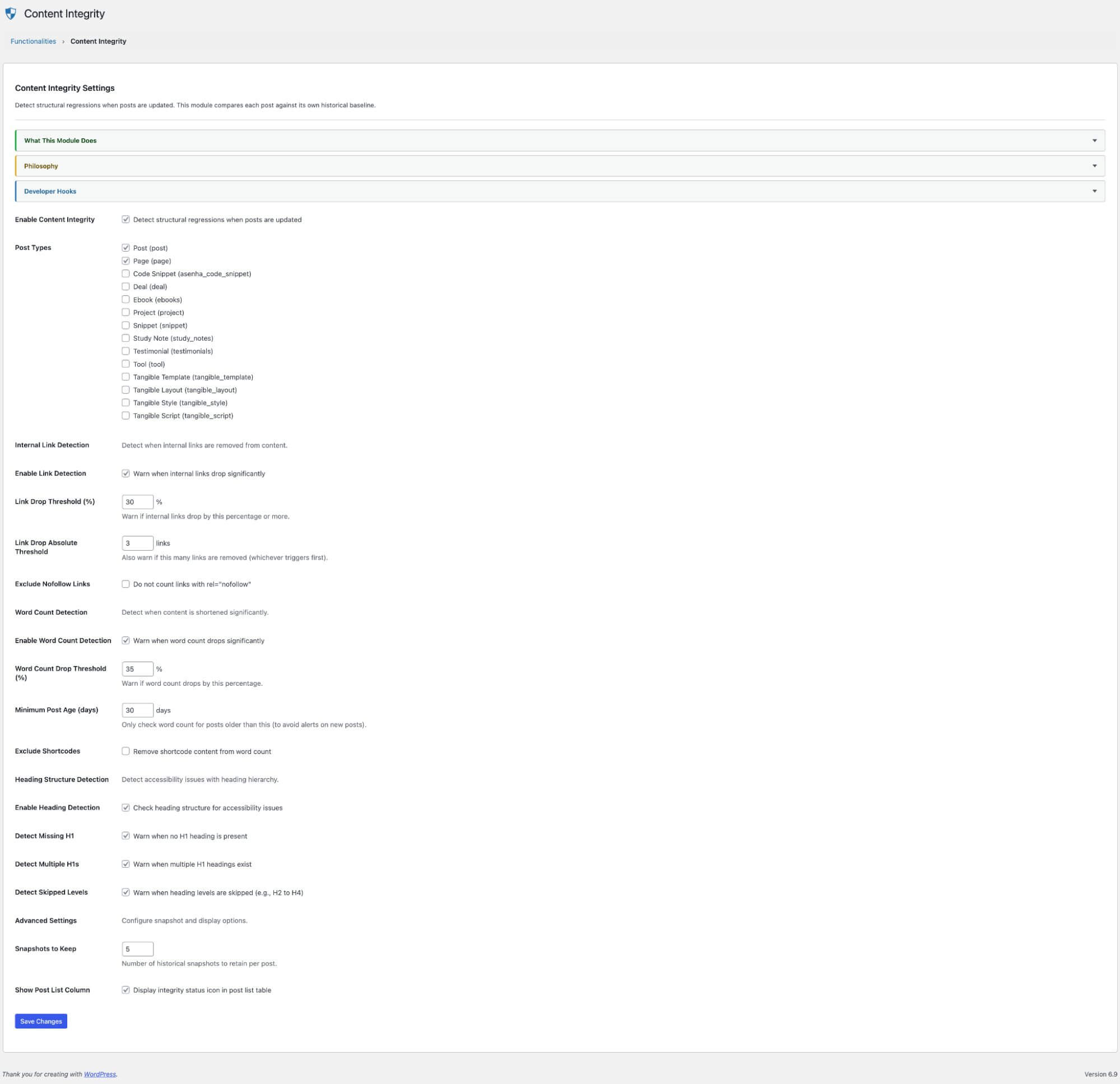
Content Integrity module
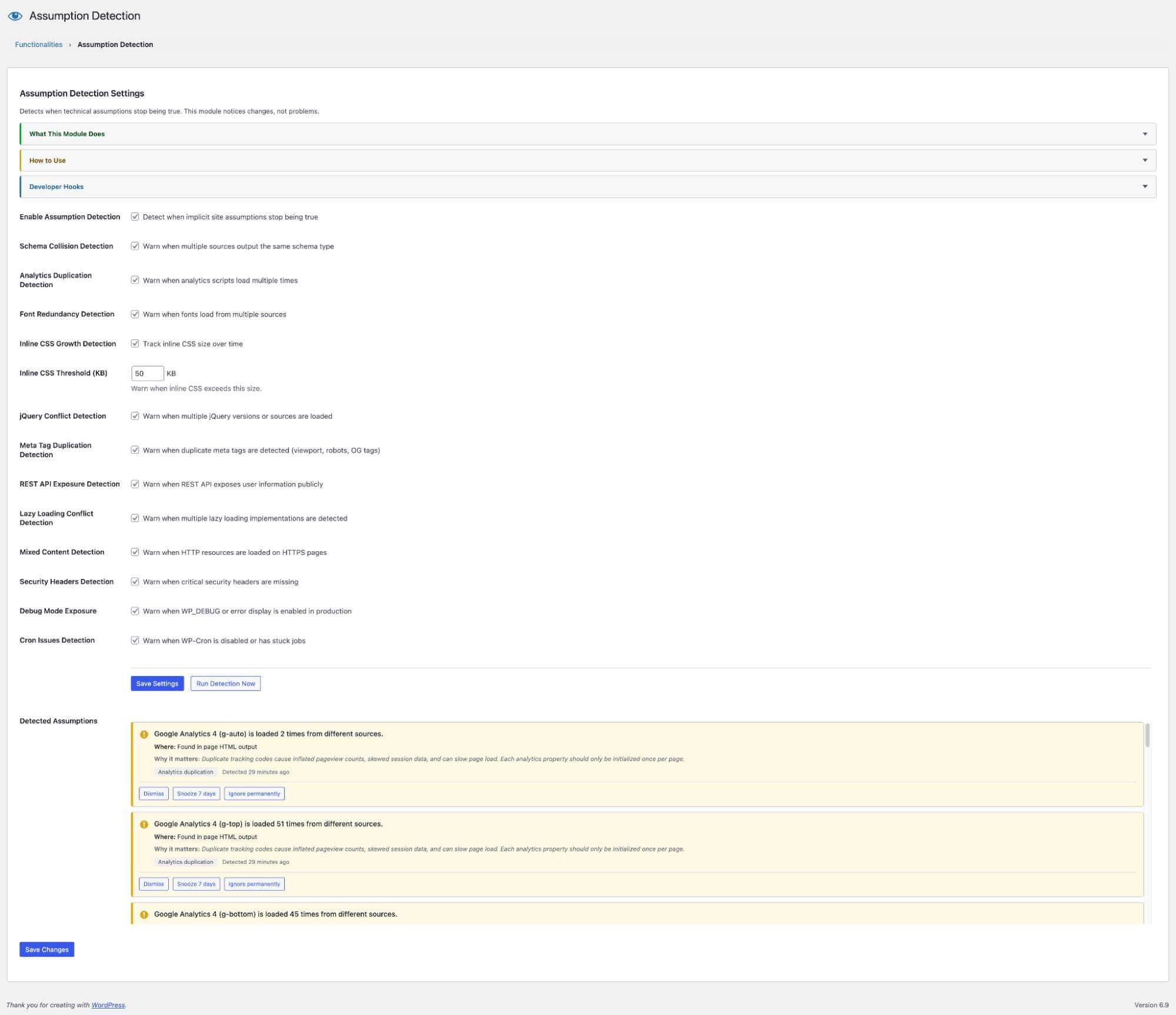
Assumption Detection module