
Glossary Tooltip automatically detects glossary terms in your WordPress website content, converts them into links, and displays clean, responsive tooltips with their definitions — helping visitors understand unfamiliar terms without leaving the page.
A built-in, searchable A–Z glossary index with live search lets visitors browse every term at a glance, while consistent internal linking between your content and its definitions improves both readability and site structure.
It’s well suited for blogs, documentation sites, knowledge bases, online courses, SaaS products, and any business, medical, financial, or legal website that relies on specialized terminology.
Learn more about Glossary Tooltip:
Official Website | Documentation | Demo | Video Tutorials | FAQs
Key Features
- Automatic term highlighting — publish a glossary term once and it’s automatically detected and linked across the post types you choose, with no manual linking.
- Responsive tooltips — definitions on hover (desktop) or tap (mobile), with configurable position, colors, width, and excerpt length.
- Searchable A–Z glossary index — a dedicated
[glossary_list]index page with alphabetical navigation, live search, categories, and flexible sorting and layout. - Categories, synonyms & aliases — organize terms into categories, and add alternate spellings or abbreviations that highlight and link back to the same term.
- Per-post and per-term overrides — turn highlighting or tooltips on or off for individual posts, pages, or specific terms, independent of the global settings.
- Flexible parsing controls — limit highlighting to chosen post types, skip headings and existing links, exclude specific HTML tags, control repeat/skip behavior, and exclude content with the
[glossary_exclude]shortcode. - Built for performance — optional content caching, footer script loading, inline asset delivery, and smart parsing that skips content with no matching terms.
- Settings backup & migration — export or import all plugin settings as JSON, reset to defaults, and move glossary terms between sites with WordPress’s built-in Tools Export/Import.
Shortcodes
This plugin includes two shortcodes: [glossary_list] to display your glossary index, and [glossary_exclude] to turn off glossary highlighting on part or all of a specific post or page.
[glossary_list]
Add this shortcode to any post or page to display your full glossary list there — an alphabetically organized (A-Z) list of all your glossary terms, with optional jump navigation and a live search box.
Basic example, showing every glossary term with the default settings:
[glossary_list]
Supported attributes
category="all"— Only show terms assigned to one or more Glossary Categories. Use a single category slug (e.g.category="seo"), or several separated by commas to show terms matching any of them (e.g.category="seo,wordpress"). Defaults toall, which shows every term regardless of category.orderby="name"— Chooses how terms are sorted within each A-Z letter group. A term never moves out of its own letter group — only the order of terms inside each group, and the order the groups themselves appear in, followorderby/ordertogether. Accepted values:name(alphabetical),date(publish date),menu_order(the custom order set on the Glossary Terms screen), orrand(random order, reshuffled on every page load — group order is unaffected byorderin this case). Defaults toname.order="ASC"— Sets the sort direction used byorderby, and also the direction the A-Z letter groups themselves run in. Accepted values:ASC(ascending — groups run A to Z, terms sort oldest to newest fororderby="date") orDESC(descending — groups run Z to A, terms sort newest to oldest fororderby="date"). Defaults toASC. Has no effect on term order whenorderby="rand", and no effect on group order at all whenorderby="rand".letters="show"— Shows or hides the big A-Z letter heading above each group of terms. Accepted values:showorhide. Defaults toshow.limit="-1"— The maximum number of terms to display per A-Z letter group — not a total for the whole index. For example,limit="2"shows at most 2 terms under A, at most 2 under B, at most 2 under C, and so on. Use-1for no limit, showing every matching term. Defaults to-1.columns="2"— How many columns to arrange the terms into within each letter group. Accepts a whole number from1to6. Defaults to2.
Examples
Show only terms from the “SEO” category:
[glossary_list category="seo"]
Combine multiple attributes — “Web Development” terms only, newest first, up to 5 per letter, in 3 columns:
[glossary_list category="web-development" orderby="date" order="DESC" limit="5" columns="3"]
Add [glossary_exclude] marker to a specific post or page to turn off automatic glossary term highlighting for part or all of that content — the rest of your site keeps highlighting as normal.
It doesn’t display anything itself; the marker(s) are simply removed from the page when it renders and it supports two forms:
Paired form — wraps a specific section and excludes only that section, leaving the rest of the post highlighted normally:
[glossary_exclude]This paragraph will not have any glossary terms highlighted.[/glossary_exclude]
You can use the paired form as many times as you like in the same post — each pair excludes only the content between it.
Single-marker form — placed on its own, excludes everything from that point to the end of the content:
[glossary_exclude]
This is useful for pages where you don’t want glossary tooltips to appear in part or all of the content, such as a legal page, a code tutorial, or a post that already discusses a term in detail.
Excluding the entire post has the same effect as setting the “Glossary Highlight” option to Off on that post/page’s edit screen.
Need more shortcode examples?
See the complete shortcode documentation: Glossary Tooltip >> Documentation >> Glossary Page
Multilingual sites
Glossary Tooltip stores UTF-8 content and is compatible with multilingual plugins such as WPML and Polylang.
Documentation and support
Full documentation and setup guides are available at official website glossarytooltip.com.
For questions or issues, please use the support forum.
Screenshots

Configure the plugin using the General Settings tab, including highlighting, parsing, and core behavior.

Customize the Glossary Index page layout, search, alphabetical navigation, and display options.

Manage glossary term behavior, links, excerpts, and content display from the Glossary Term settings.

Customize tooltip appearance, position, colors, mobile behavior, and display options.

Fine-tune plugin behavior with Advanced Settings for better performance and compatibility.

Frontend Glossary Index page with alphabetical navigation and integrated live search.

Automatically highlighted glossary terms with interactive tooltips displayed on hover or tap.

Browse glossary terms quickly using the alphabetical A–Z, Special Characters, and 0–9 navigation.

Instantly find glossary terms using the built-in live search terms feature.
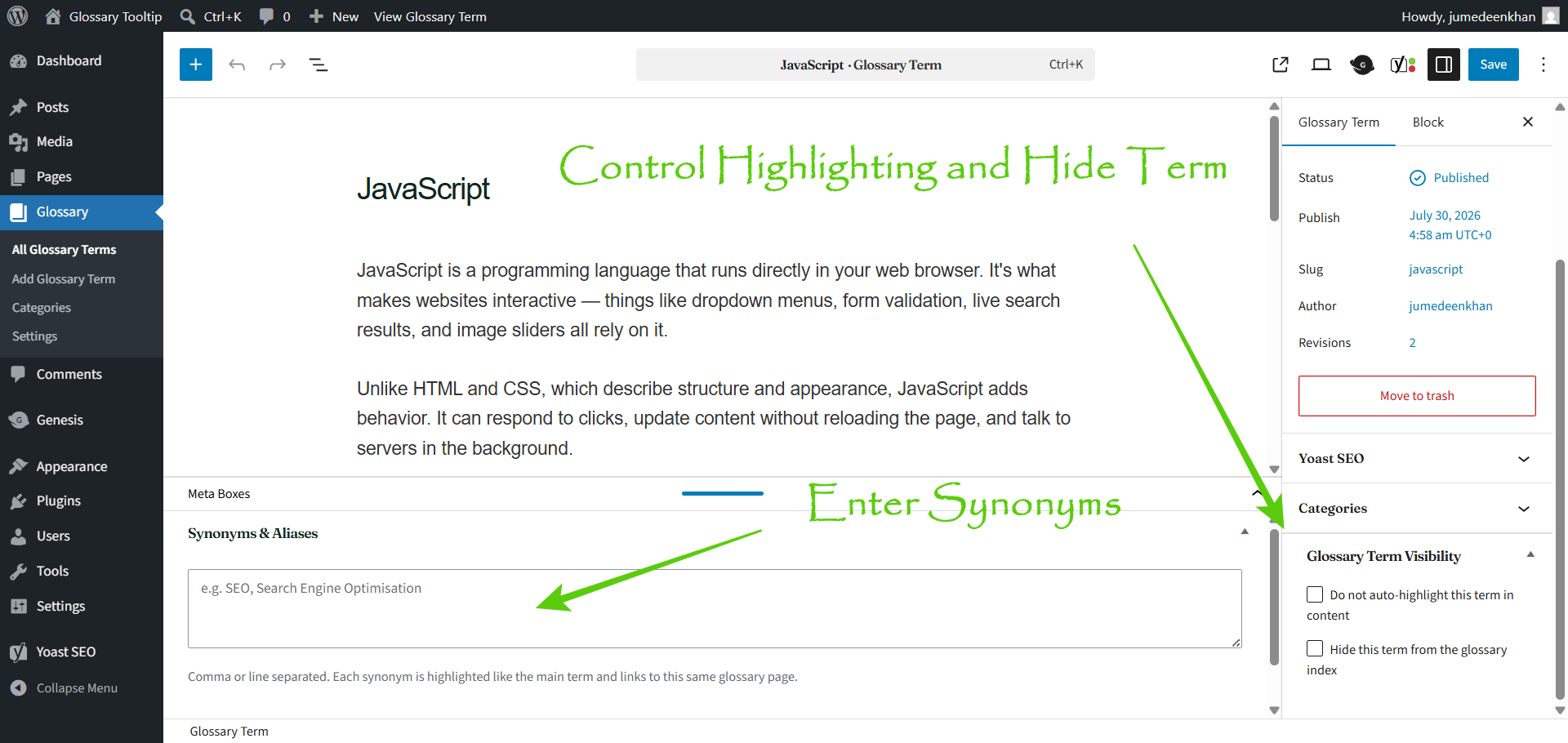
Create and edit glossary terms with descriptions, excerpts, featured images, and custom settings.

Override highlight and tooltip settings for individual posts, pages or custom post types.

Manage all glossary terms from the dedicated WordPress Glossary Terms dashboard.

Get started quickly with the Setup Wizard for easy plugin configuration.