
In most clubs the training schedule exists. Getting it onto the website and keeping it there is the work. The plan lives in a PDF that is two seasons old, the summer break is still not on the calendar, and the person who knows when the hall is free is away for three weeks.
Squadeno turns that around. You maintain the training schedule once, say Tuesday at 6 pm in the gym hall from September to June, and every single date is generated from it. Closures and school holidays block the affected sessions automatically. A cancelled session, a moved date or an extra session is handled on the date itself, and the change shows up everywhere that sport appears.
Who it is for: clubs with more than a handful of offerings that want every sport to have its own findable page, and that want trainers to keep their own dates current without being handed the keys to the whole site.
What you get
- Sports with their own SEO-friendly page; optional subgroups/disciplines (e.g. athletics kids/youth).
- Training times per sport – season- and weather-aware; location as a venue or free text.
- Automatic calendar: dates are generated from the training schedule, holidays/closures block automatically, exceptions (cancelled/rescheduled/extra date) and events are added on top.
- People with their own profile page: one record per person, whatever they do for the club. An office says what that is (trainer, chair, treasurer), offices can sit in committees, and a person may hold several.
- The board on the website: an ordinary page with one block on it, filtered to the board offices and grouped by committee. Anyone who coaches and holds an office is entered once and appears in both places.
- Venues with address, GPS, photo and an automatic “what takes place here” list.
- Events via a simple builder (open/registration, costs, single- or multi-day).
- Permissions in two layers: five task packages ticked per person (own profile, trainer, club administration, dates, public relations), plus a permission level per sport for trainers. Only the club administration may delete, and nobody can pass on a package they do not hold. Plugins, themes, users and the settings stay with the administrator.
- SEO: clean URLs, internal linking and structured data (schema.org).
- Performance: computed dates are cached (transient) and refreshed automatically on changes.
The source language of the plugin is English; a complete German translation (de_DE) is bundled. Public URL slugs default to English and can be localized per site in the settings.
Putting it on the page
Shortcodes (blocks with the same output are also available):
[csmgr_sports]– overview of all sports with filters (age group/section).[csmgr_calendar view="month"]– club-wide calendar (view="month",view="week"orview="list"for the weekly training schedule).[csmgr_upcoming sport="ID" limit="5"]– upcoming dates of a sport.[csmgr_people group="true"]– the people of the club, optionally filtered to one office (function="board") and grouped by committee.
More about the plugin
The project page at squadeno.com covers the same ground in more detail, with larger screenshots and a German version of the text.
Privacy by default
Maps are optional and switched off by default: no map data is requested from any external server until an administrator selects the map provider “OpenStreetMap” in the settings. The Leaflet map library (BSD-2-Clause) is bundled with the plugin and served locally; it is not loaded from a CDN.
External services
This plugin relies on the following third-party services. It does not send any data unless the corresponding feature is used.
OpenStreetMap map tiles (optional, disabled by default) – Maps are off out of the box: the setting “Map provider” (Club Sports Settings Calendar & maps) defaults to “none”, and while it is set to “none” the plugin contacts no map server at all, neither on the public website nor in the WordPress admin area. Only after an administrator explicitly selects “OpenStreetMap” does the browser load map tiles directly from the OpenStreetMap tile servers (tile.openstreetmap.org), on venue pages with coordinates and on the venue editor screen in wp-admin. This transmits the IP address and the requested map section to OpenStreetMap. As a fallback for visitors without JavaScript, an embedded map from openstreetmap.org may be displayed. No tracking, analytics or usage data is collected by the plugin or sent anywhere.
Terms/attribution: https://www.openstreetmap.org/copyright – Privacy policy: https://wiki.osmfoundation.org/wiki/Privacy_Policy
Nominatim geocoding (OpenStreetMap) (optional, disabled by default) – Part of the same opt-in: only when the map provider “OpenStreetMap” is enabled, and only when an editor clicks the “Determine coordinates from address” button in the venue editor, the address typed into the form is sent to the Nominatim service (nominatim.openstreetmap.org) to look up coordinates. It is never called on the public website, and it is not called at all while maps are disabled.
Usage policy: https://operations.osmfoundation.org/policies/nominatim/ – Privacy policy: https://wiki.osmfoundation.org/wiki/Privacy_Policy
Cloudflare Turnstile (optional, disabled by default) – Only if an administrator enables Turnstile in the settings, the plugin loads the Turnstile widget script from Cloudflare (challenges.cloudflare.com) on pages that show a trainer contact form, and on submission sends the challenge token together with the visitor’s IP address to Cloudflare for bot verification. When Turnstile is disabled, no data is sent to Cloudflare.
Terms of use: https://www.cloudflare.com/website-terms/ – Privacy policy: https://www.cloudflare.com/privacypolicy/
Source code and build
The plugin ships with the complete, human-readable source of every generated file, plus the tooling needed to regenerate it. Nothing is obfuscated.
Editor blocks – build/<block>/index.js is generated and minified. The readable ES module source of each of these files is included in the plugin under blocks/<block>/index.js (same folder name, e.g. blocks/kalender/index.js build/kalender/index.js).
Build tooling: @wordpress/scripts (webpack + Babel), declared in the bundled package.json / package-lock.json. To regenerate the files from the shipped sources, run inside the plugin folder:
npm ci
npm run build
which executes wp-scripts build --webpack-src-dir=blocks and writes build/.
PHP – All PHP is plain, unminified source under src/ (PSR-4, autoloaded via Composer; see the bundled composer.json / composer.lock). assets/js/*.js and assets/css/*.css are hand-written and unminified as well.
Third-party libraries
- Leaflet 1.9.4 – interactive maps, BSD-2-Clause. Bundled locally in
assets/vendor/leaflet/(upstream distribution build, includingLICENSE); it is never loaded from a CDN. Project and full source: https://github.com/Leaflet/Leaflet – release used: https://github.com/Leaflet/Leaflet/releases/tag/v1.9.4
Screenshots
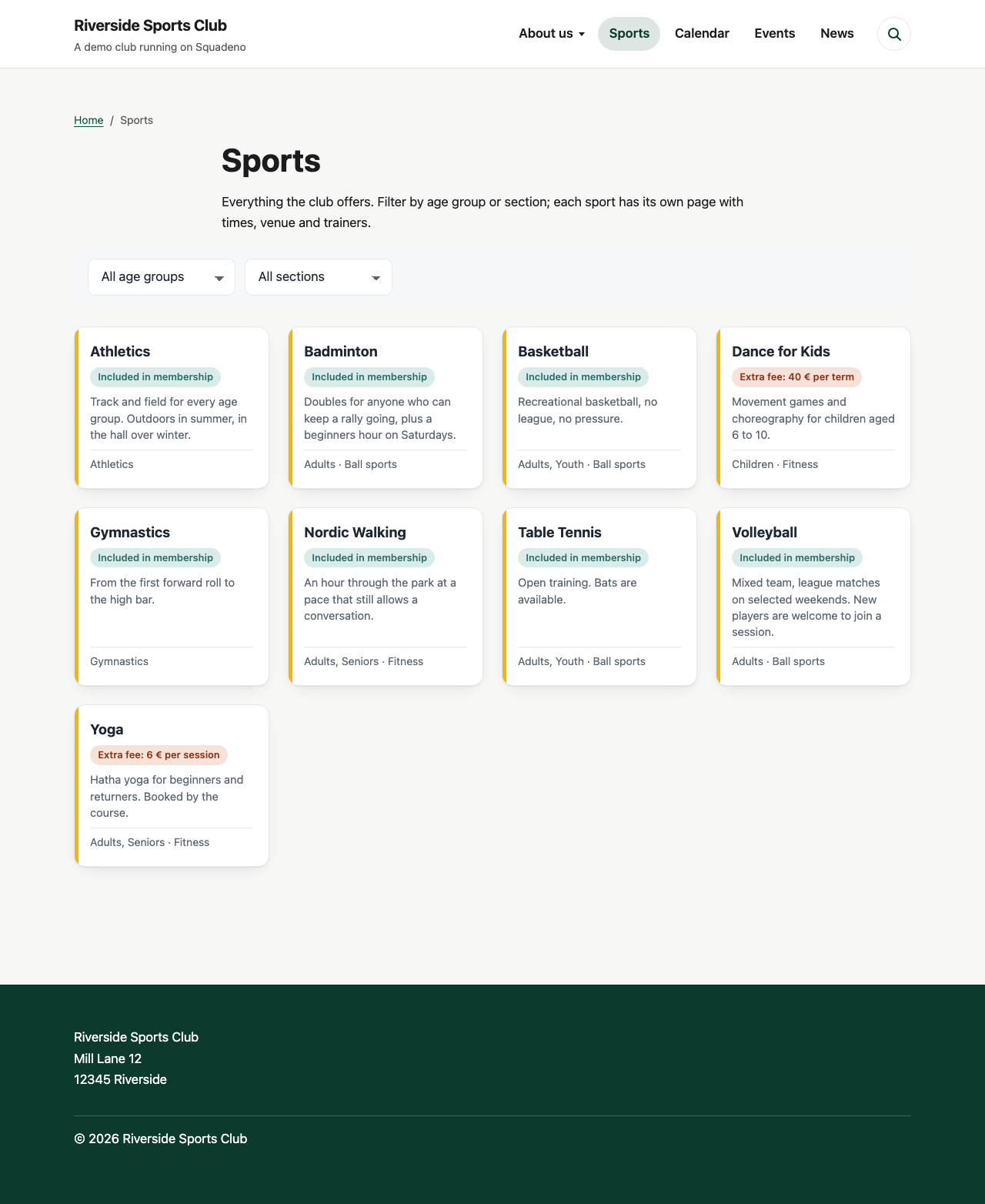
All sports at a glance on the website, with filters for age group and section.
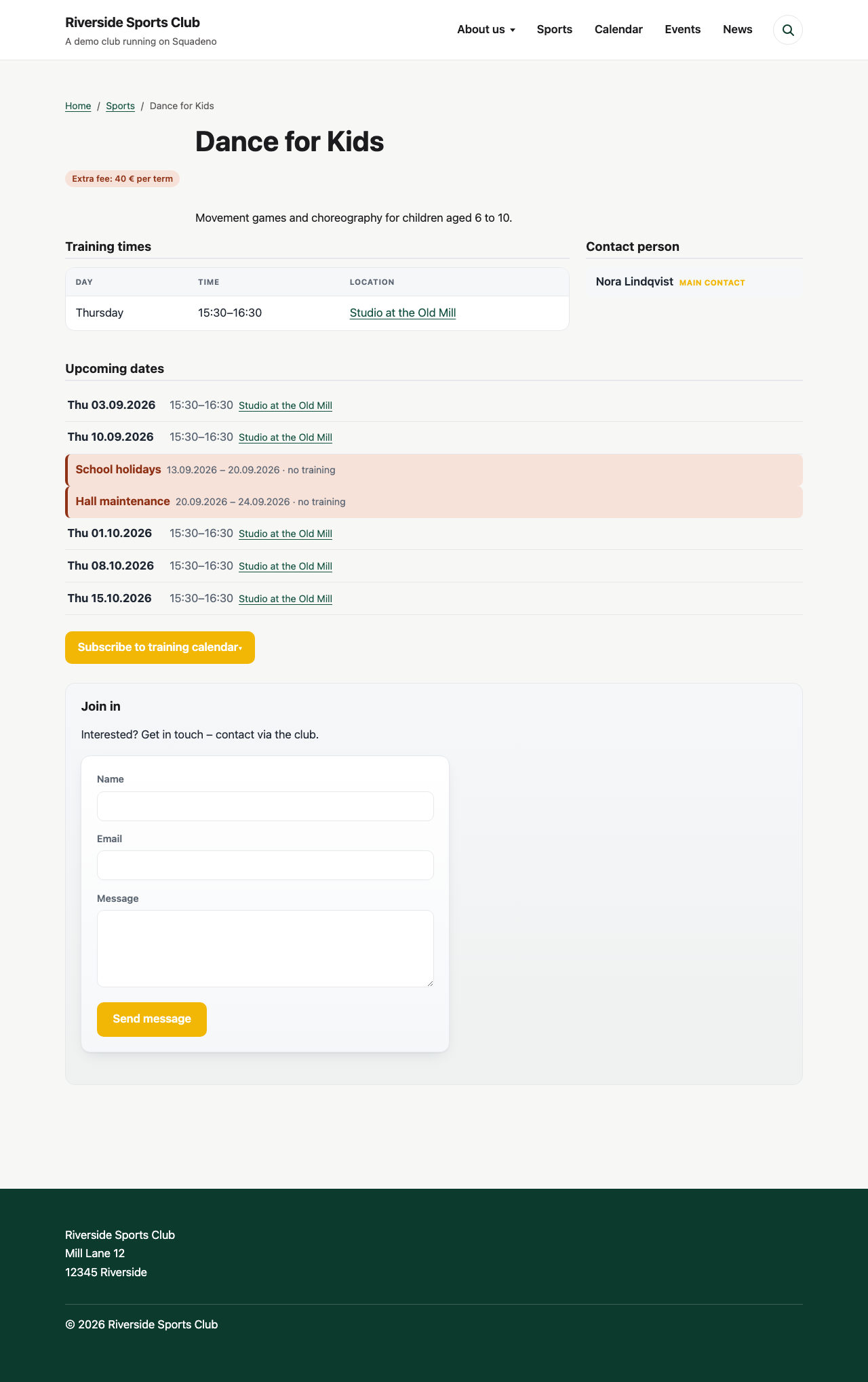
A sport's own page: training times, contacts and the automatically generated upcoming dates – holidays are blocked automatically.
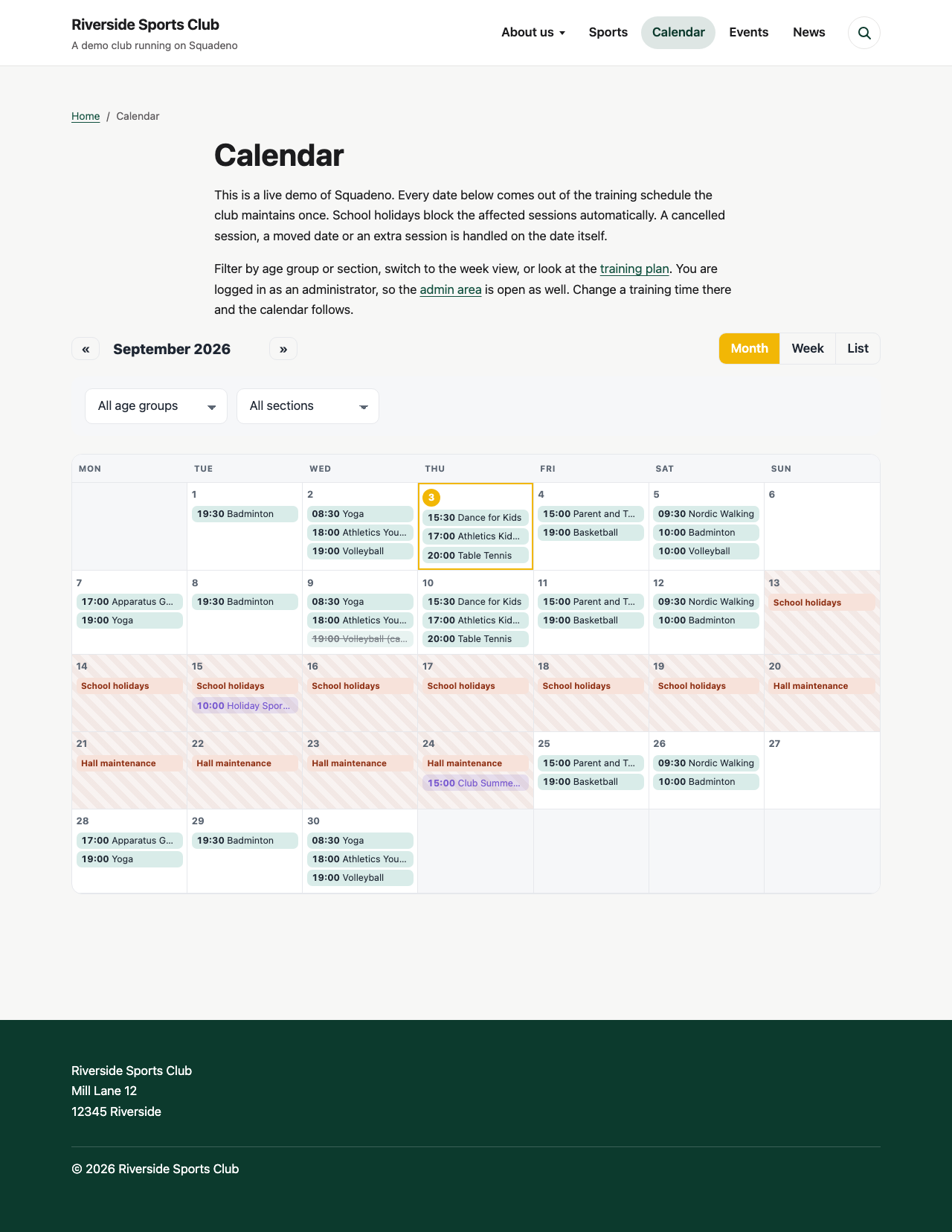
The club-wide calendar (month or week view) with trainings, events and closures. School holidays block the affected sessions, a cancelled one stays visible and struck through.
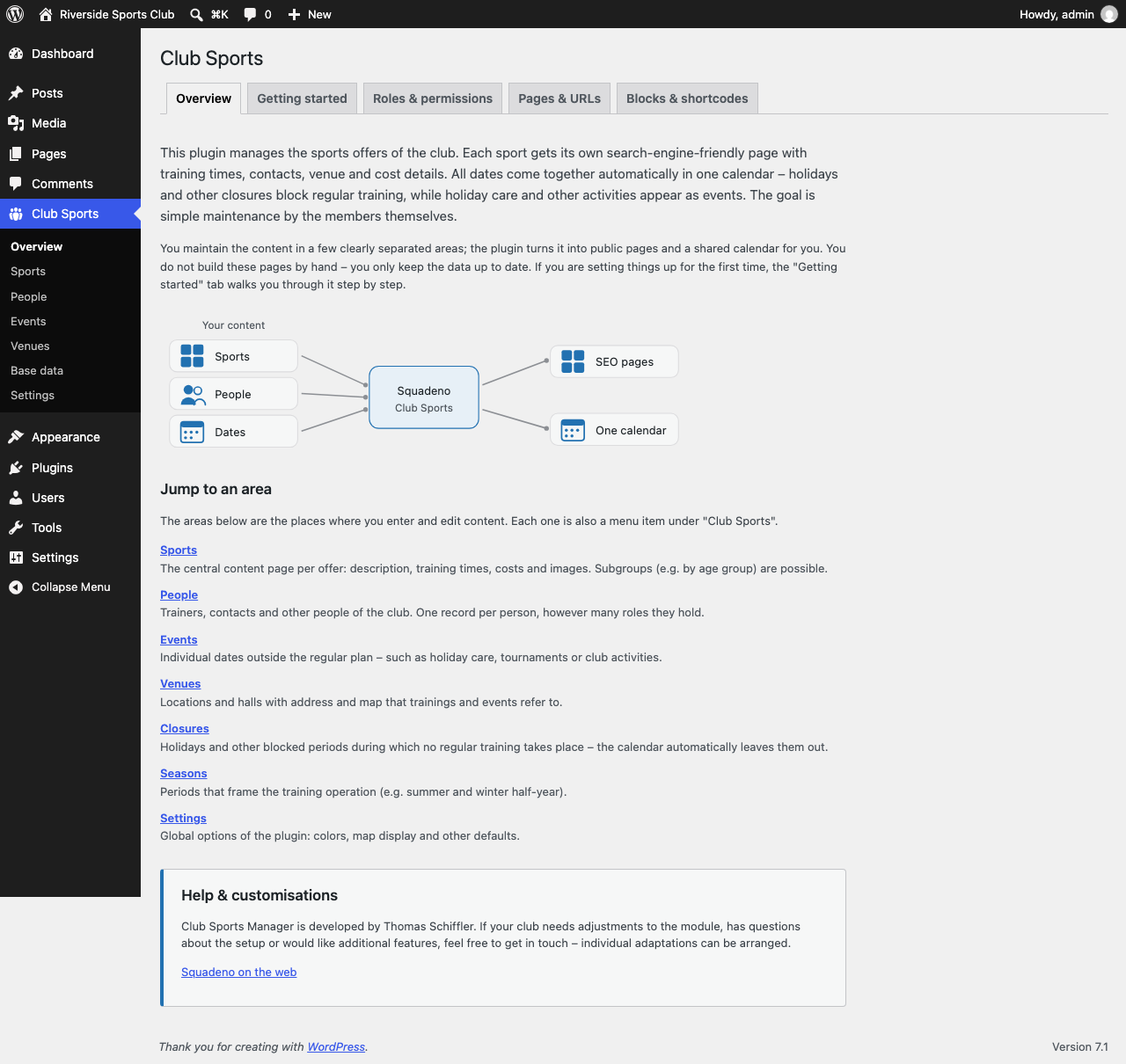
The admin overview introduces new users to the plugin and where to maintain content.
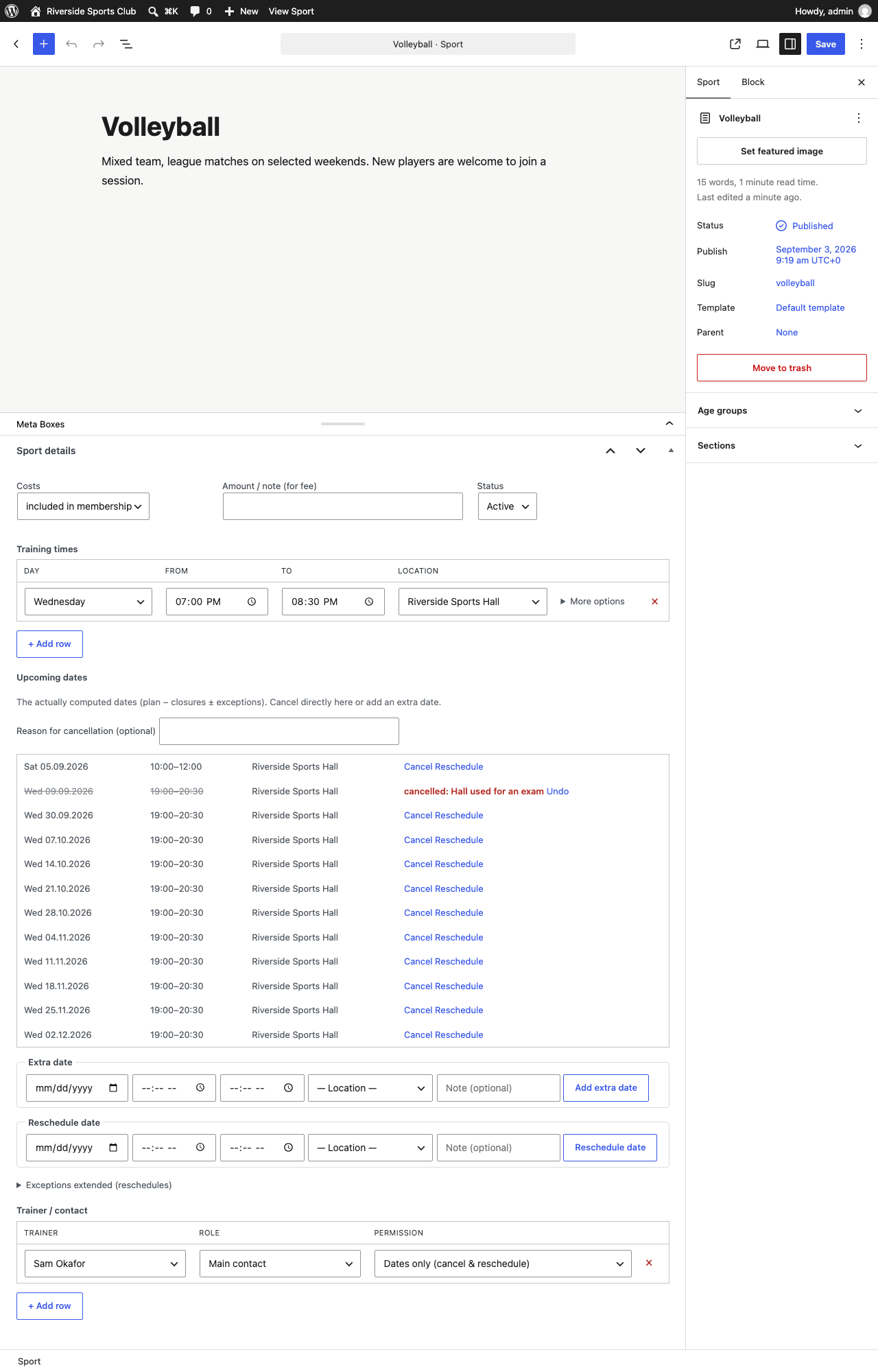
Maintaining a sport: the weekly training time, the dates computed from it with cancel and reschedule right there, fields for an extra or a moved session, and the trainers with their permission level.
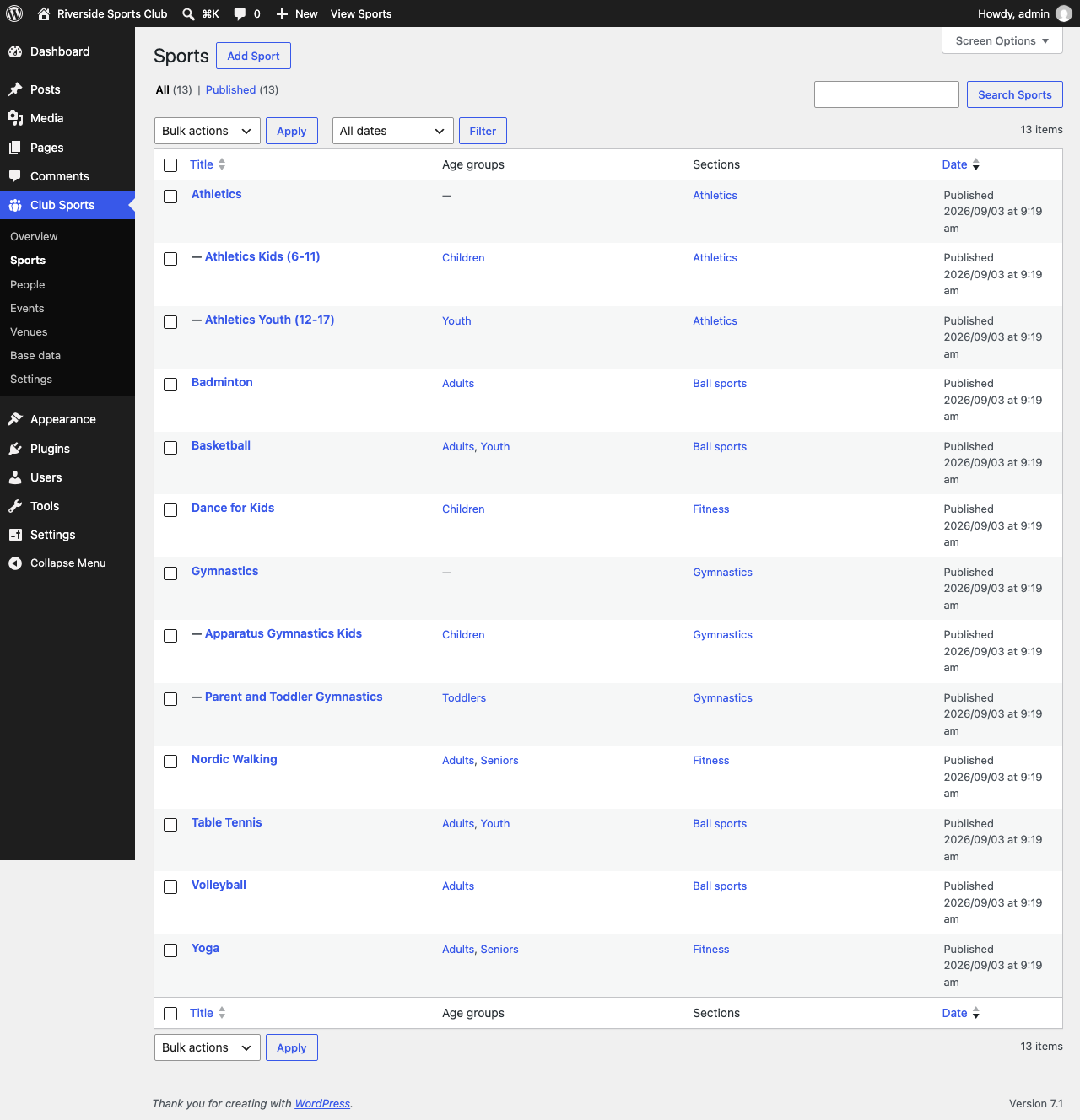
All sports in the admin area, with their sub-groups, age groups and sections.
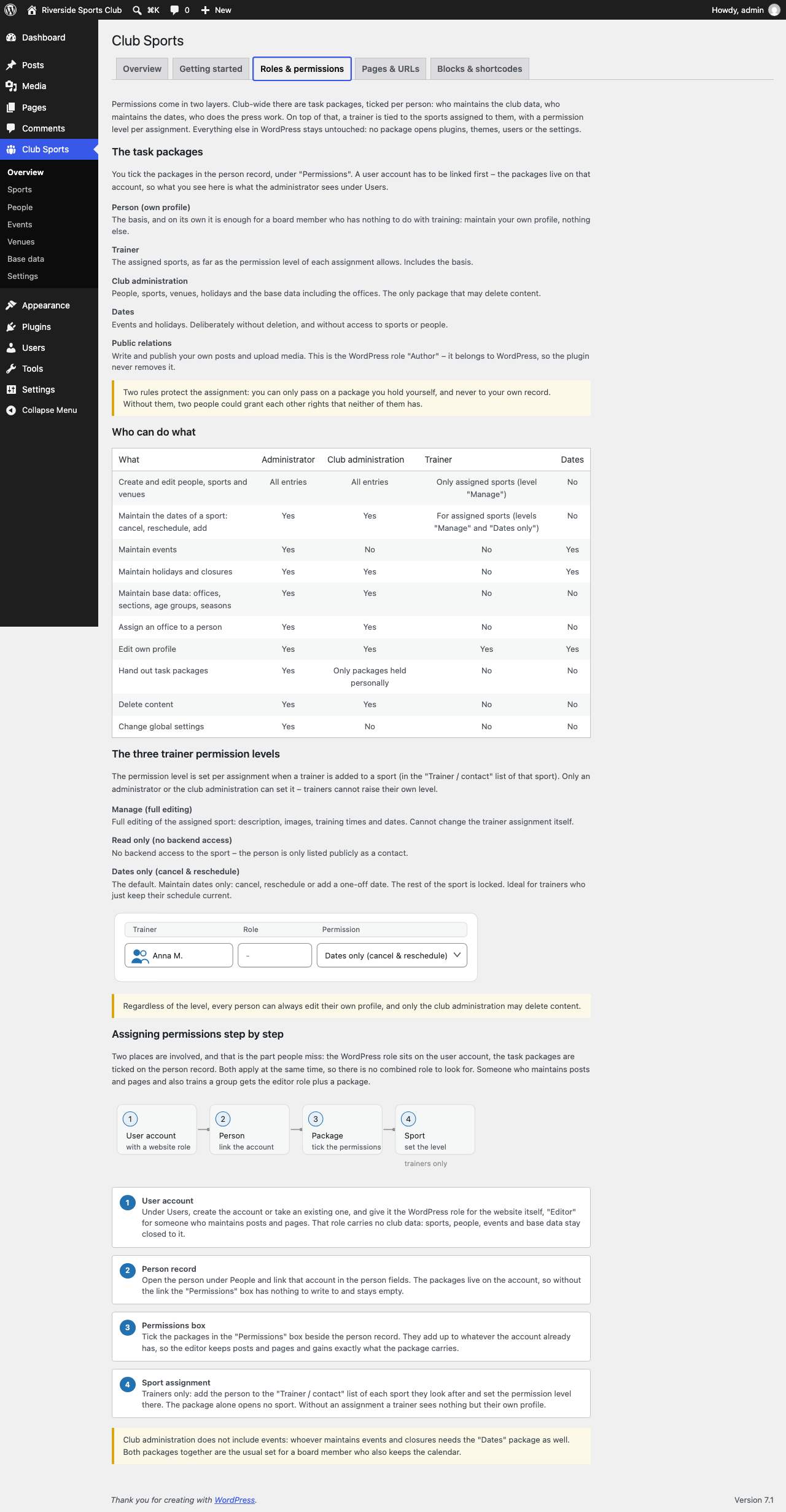
Permissions in two layers: five task packages ticked per person, and a permission level per sport for trainers.
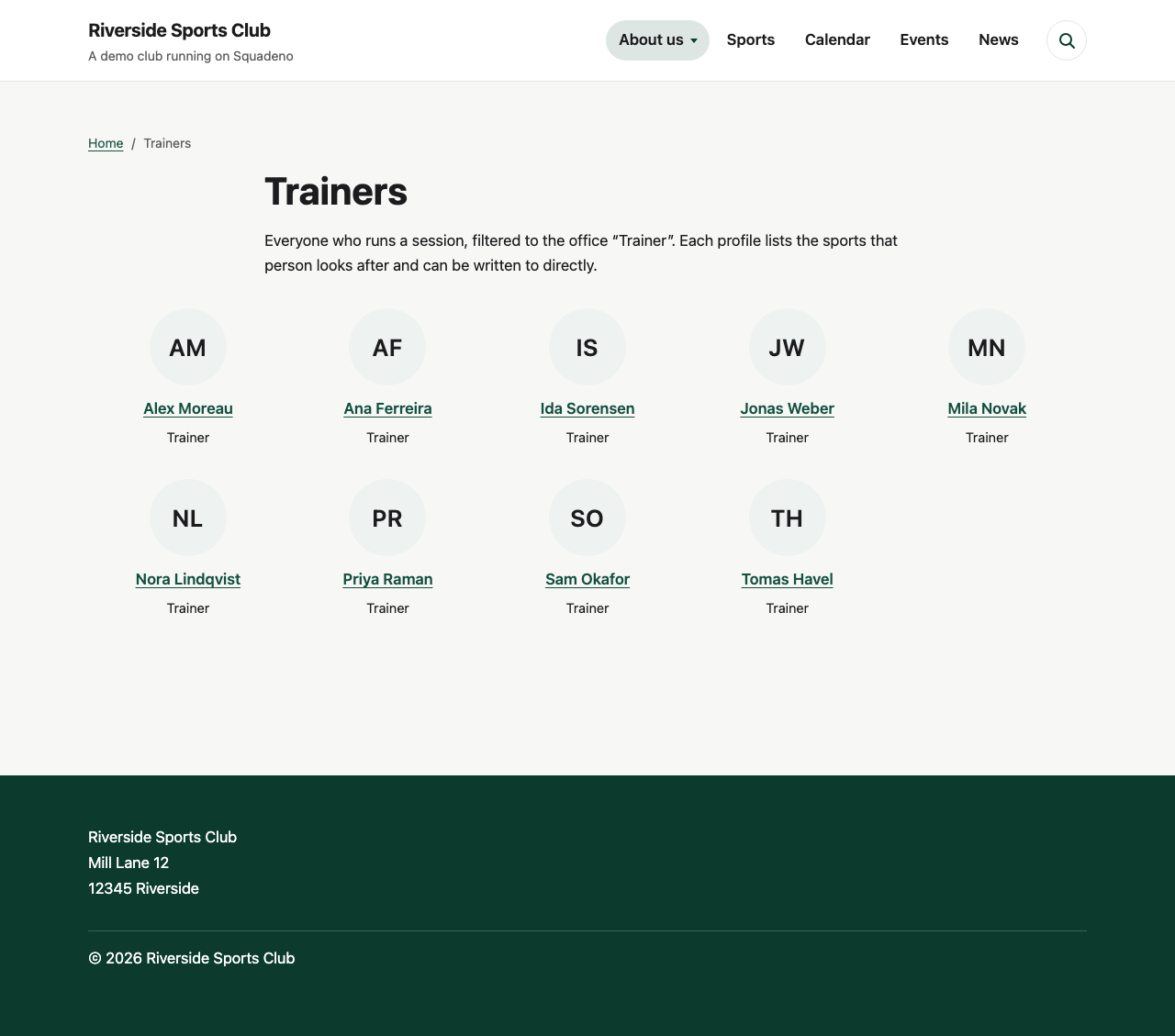
The trainers as their own page, filtered to the office "Trainer".
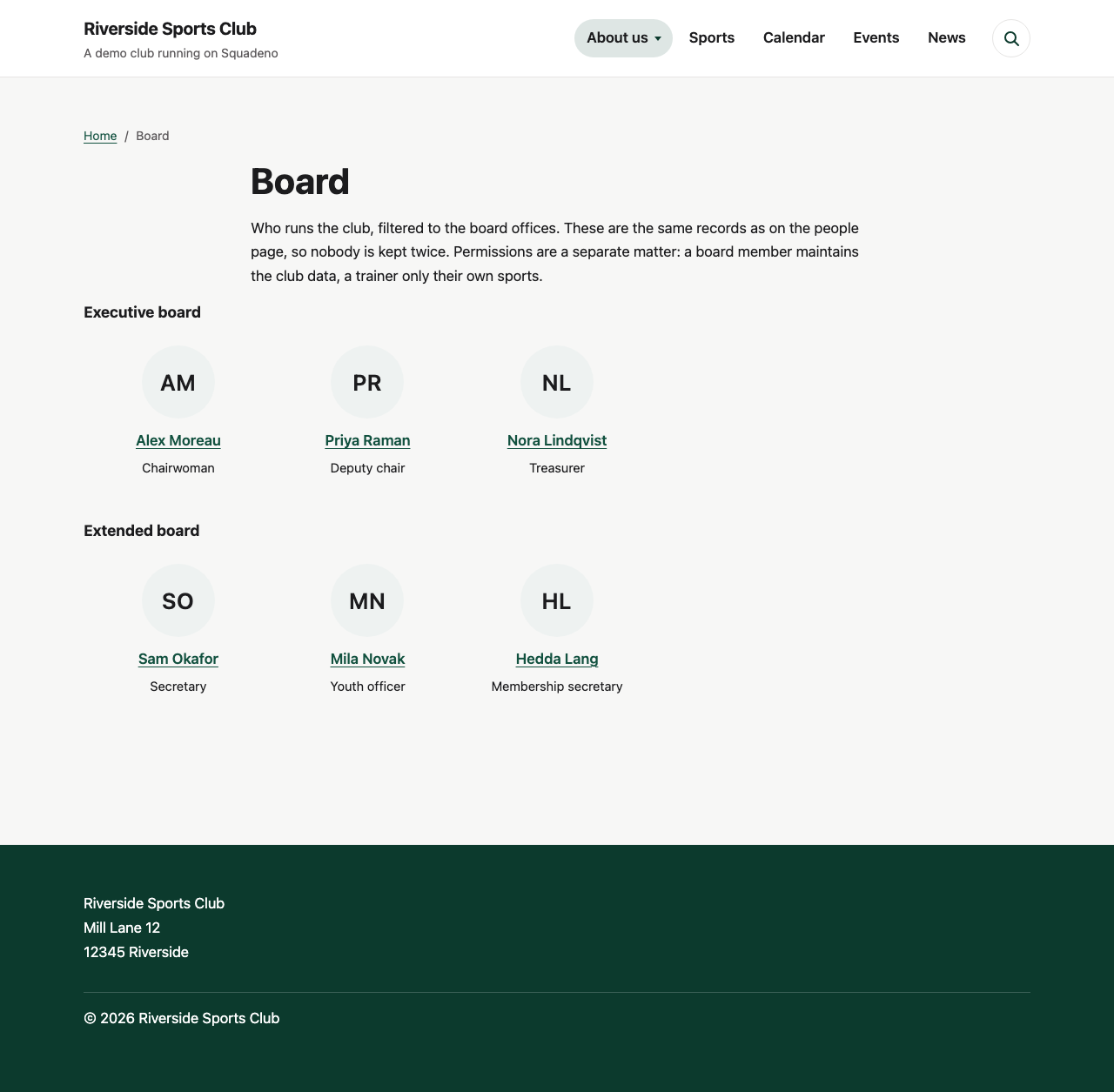
The board as its own page, filtered to the board offices and grouped by committee. These are the same records as the trainers, so nobody is kept twice.